Tasting Palma logo

BOOK NOW

Category: Uncategorized

  • Pa amb Oli: Mallorca’s National Dish, Explained

    Pa amb Oli: Mallorca’s National Dish, Explained

    At A Glance

    Pa amb oli means bread with oil, and in Mallorca it is not a snack or a side. It is a full meal, and it is the island’s national dish.

    • Three non-negotiable parts: pa moreno bread, tomàtiga de ramellet, and island olive oil.
    • The ramellet tomato is rubbed on, not sliced on. That is the whole technique.
    • It is not Catalan pa amb tomàquet. Different tomato, different bread, different role on the table.
    • Toppings are the variable: Mahon cheese, cured ham, sobrassada, anchovies.
    • Order it at a celler and it arrives as a board you assemble yourself.

    Pa amb oli is the dish that explains Mallorca. It is bread, tomato, olive oil and salt, it costs almost nothing to make, and it has been feeding this island for centuries. Every Mallorcan grew up on it, every celler serves it, and a visitor who orders it once and understands what they are eating has learned more about the place than a week of restaurant menus would teach them.

    It is also routinely misunderstood by visitors, who order it expecting a bruschetta and receive a wooden board with raw components on it and no instructions. That is not a mistake. Assembling it yourself is the point, and there is a right way to do it.

    This guide covers what pa amb oli actually is, the three ingredients that matter, how it differs from the Catalan dish it gets confused with, how to assemble it properly, and where to eat it in Palma. If you want the wider context, our Palma food guide covers the island’s other essential dishes.

    What Is Pa amb Oli?
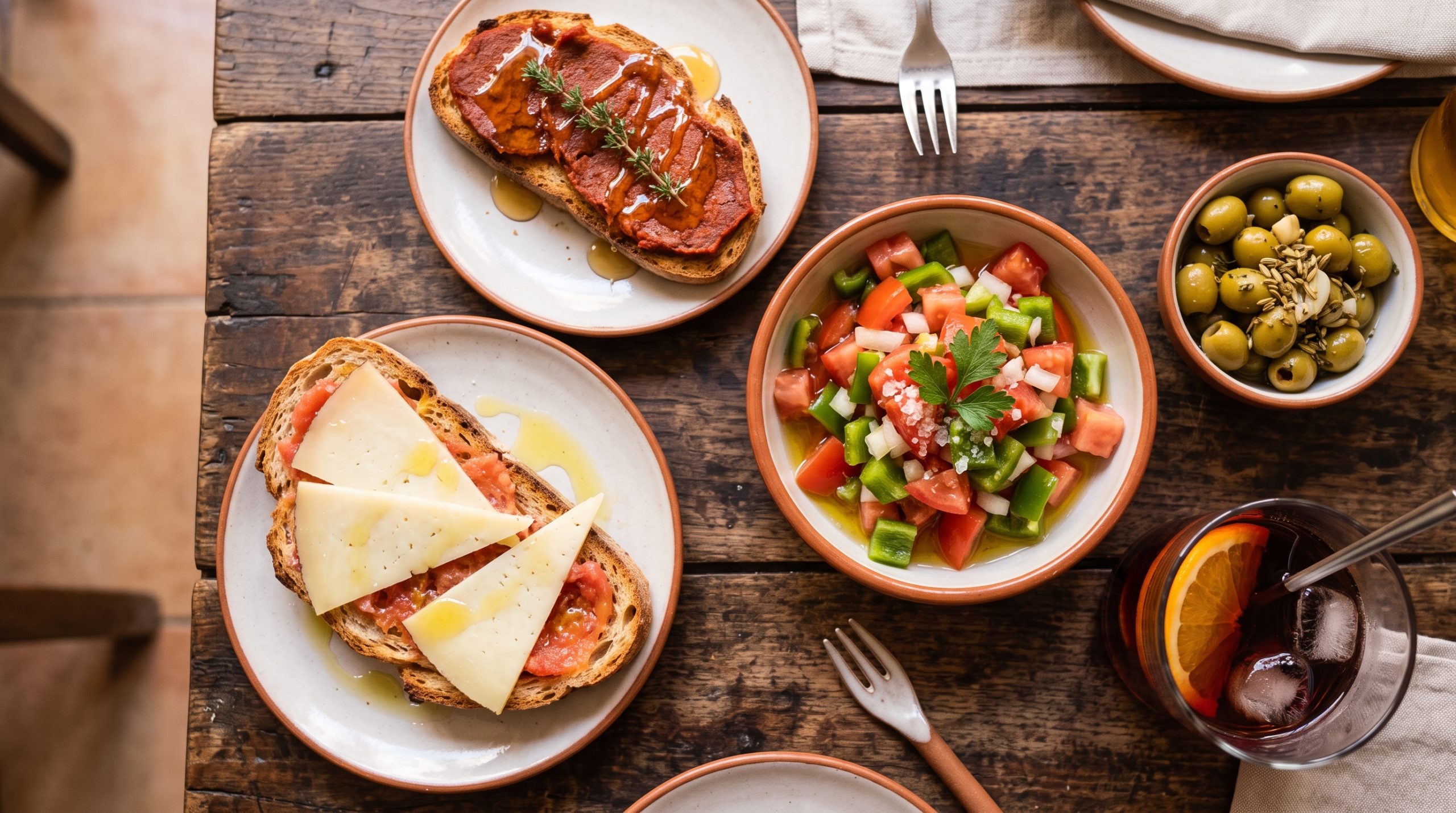
    Overhead view of Mallorcan tapas including pa amb oli, sobrasada on toast, trampo salad and vermouth
    Pa amb oli on a Mallorcan table, where it usually arrives alongside everything else.

    The name is Mallorquín and translates literally as bread with oil. At its most basic that is exactly what it is: a slice of rustic brown bread, rubbed with a halved tomato, drizzled with extra virgin olive oil and finished with salt. Sometimes garlic is rubbed on first.

    What turns it from a snack into a meal is what goes on top. A proper pa amb oli in a Mallorcan celler arrives with cured ham, Mahon cheese, anchovies, olives, sometimes sobrassada, and you build each slice as you go. Two people can eat well from one board, and it will cost considerably less than any other route to a full dinner.

    The dish predates the tomato entirely. Bread and olive oil is an ancient Mediterranean combination and Mallorcans were eating it long before tomatoes reached Europe from the Americas. The tomato is a relatively recent addition to a very old idea, which is worth remembering when someone insists there is only one correct version.

    The Three Ingredients That Make Real Pa amb Oli

    A crate of ramellet tomatoes, the small ribbed Mallorcan variety used for pa amb oli
    The tomàtiga de ramellet: small, ribbed and grown to be hung and kept, not sliced into salads.

    Get these three right and the dish works. Get any of them wrong and you have made something else.

    IngredientWhat it must beWhy it matters
    Pa morenoMallorcan brown country bread, ideally baked that dayDense enough to take oil without collapsing; traditionally made without salt
    Tomàtiga de ramelletSmall vine tomato, hung in stringsThick bitter skin, intense flesh, keeps for months; rubbed not sliced
    Olive oilExtra virgin, ideally Oli de MallorcaIt is a main ingredient here, not a dressing. Be generous
    The three components of a genuine Mallorcan pa amb oli.

    Pa moreno is the Mallorcan brown loaf, dense and open-crumbed, and traditionally made without salt. That last detail matters: unsalted bread is why the dish needs salt added at the table, and why a salted supermarket loaf throws the balance off. It should be a day old rather than fresh from the oven, because slightly stale bread takes oil better.

    Tomàtiga de ramellet is the ingredient nobody outside Mallorca has. It is a small vine tomato with a hard, faintly bitter skin and unusually concentrated flesh, grown specifically because it stores. Hung in strings in a cool room it keeps for months, in some accounts up to nine, which is precisely why an island with hot dry summers built a national dish around it. You will see the strings hanging in market stalls and in kitchens.

    Olive oil here is not a finishing drizzle. Mallorca has its own protected designation, Oli de Mallorca, and the oil is a structural part of the dish rather than a garnish. Islanders use considerably more than a visitor expects. If you think you have added too much, you are probably close to right.

    Pa amb Oli vs Pa amb Tomàquet: The Difference
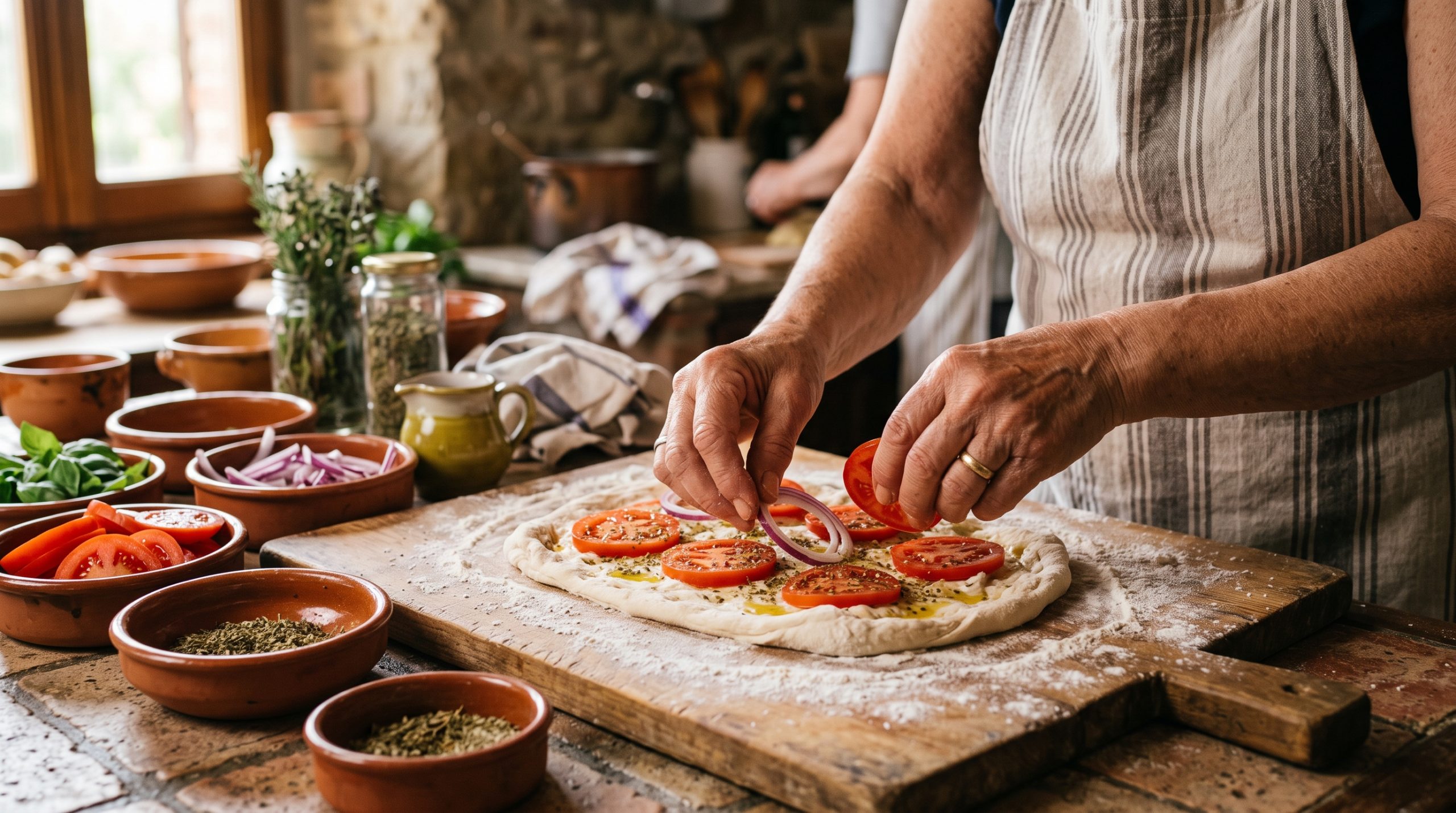
    Hands assembling a Mallorcan coca flatbread with sliced tomato and onion on a floured board
    Mallorcan bread cookery is its own tradition, related to the Catalan one but not the same.

    Visitors who have been to Barcelona often assume these are the same dish with different names. They are related, they are not identical, and telling a Mallorcan they are the same is a reliable way to start a long conversation.

    The Catalan pa amb tomàquet uses ordinary ripe tomatoes and is usually a side dish or a starter, served alongside something else. The Mallorcan pa amb oli uses the ramellet tomato specifically, uses the darker pa moreno rather than white bread, and functions as a meal in its own right rather than an accompaniment.

    There is also a chronological argument that Mallorcans enjoy making: bread with oil came first, and bread with oil and tomato is its descendant. Whether or not you find that decisive, the practical difference is real. Order pa amb tomàquet in Barcelona and you get a plate of prepared bread. Order pa amb oli in a Mallorcan celler and you get a board of raw parts and a job to do.

    How to Assemble Pa amb Oli Properly
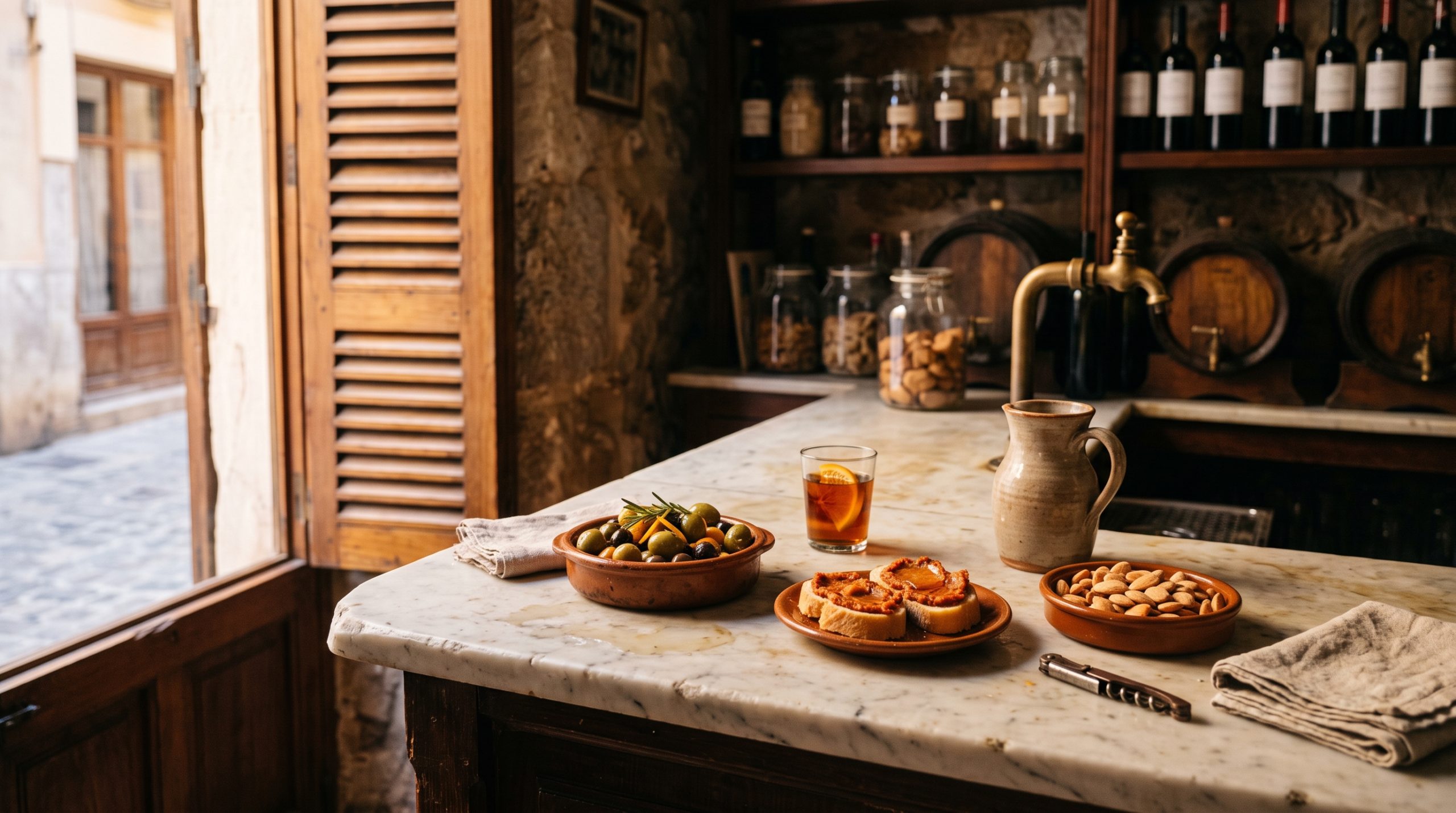
    Small plates of olives, sobrasada toast and almonds on a marble bodega counter in Palma Old Town
    In a bodega it arrives as components. Building it is expected of you.

    The board arrives with bread, a halved tomato or a small bowl of them, a bottle of oil, salt, and whatever toppings you ordered. There is an order of operations and getting it wrong is the most visible thing a visitor does in a Mallorcan restaurant.

    How To Build A Pa amb Oli

    • 1. Garlic, if you want it. Rub the cut clove across the bread first, lightly.
    • 2. Rub the tomato. Cut side down, pressed and dragged across the slice until the bread is stained. Do not slice it on top.
    • 3. Oil, generously. More than feels correct. It should soak in, not sit on the surface.
    • 4. Salt. The bread is unsalted, so this is not optional.
    • 5. Topping last. Ham, cheese, anchovy or sobrassada goes on at the end.
    • 6. Eat it immediately. Built bread does not wait. Assemble one slice at a time.

    The tomato step is the one that separates people. You are not putting tomato on the bread, you are putting tomato into it. The ramellet’s tough skin is what makes this work: it holds together while the flesh and juice go into the crumb, and you discard what is left. A soft salad tomato disintegrates and gives you wet bread.

    Assemble as you eat rather than building the whole board at once. Bread that has been sitting under oil and tomato for ten minutes has gone soggy, and half the pleasure of the dish is the contrast between the crisp edge of the crust and the soaked centre.

    What to Put on Pa amb Oli
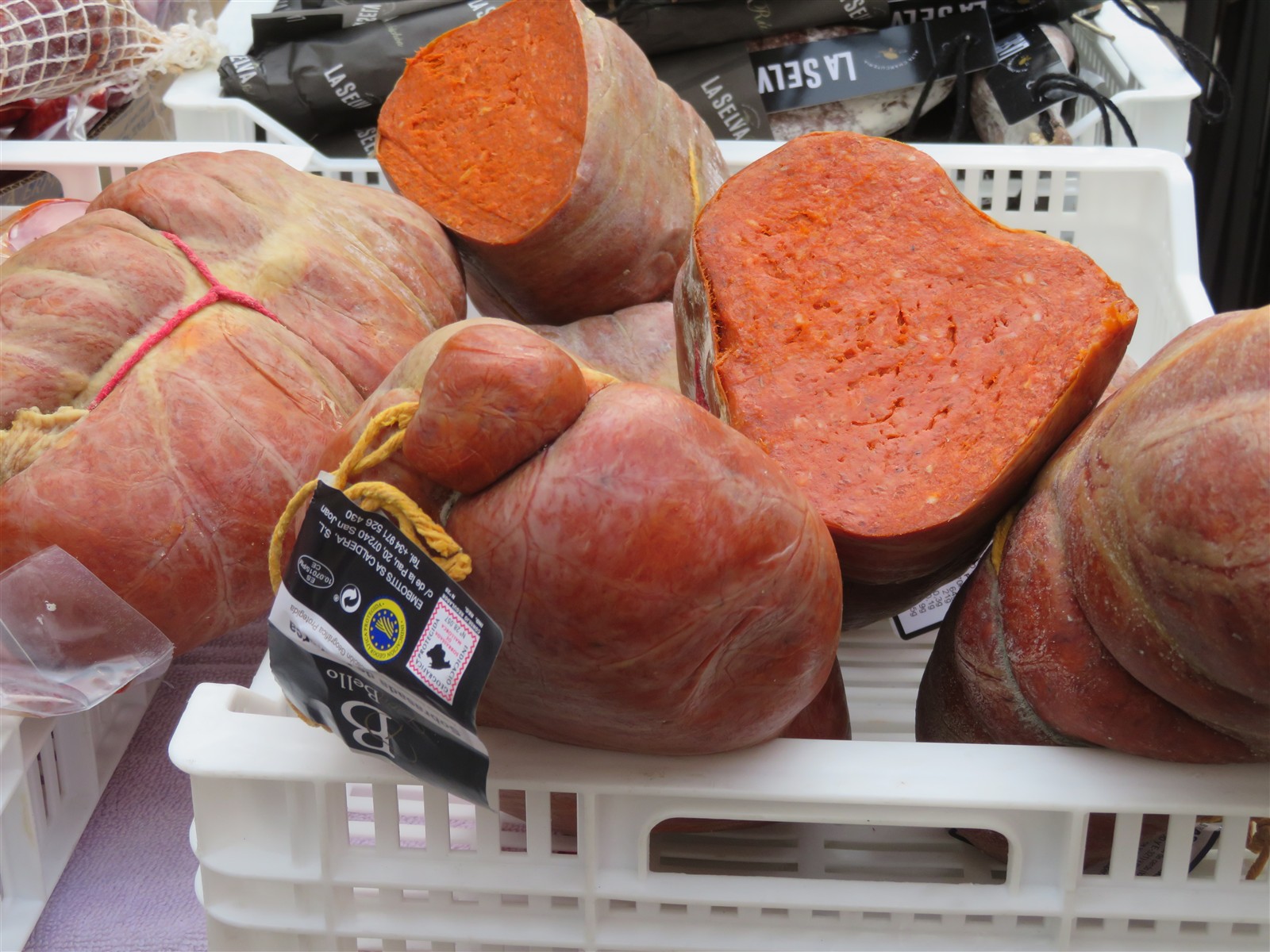
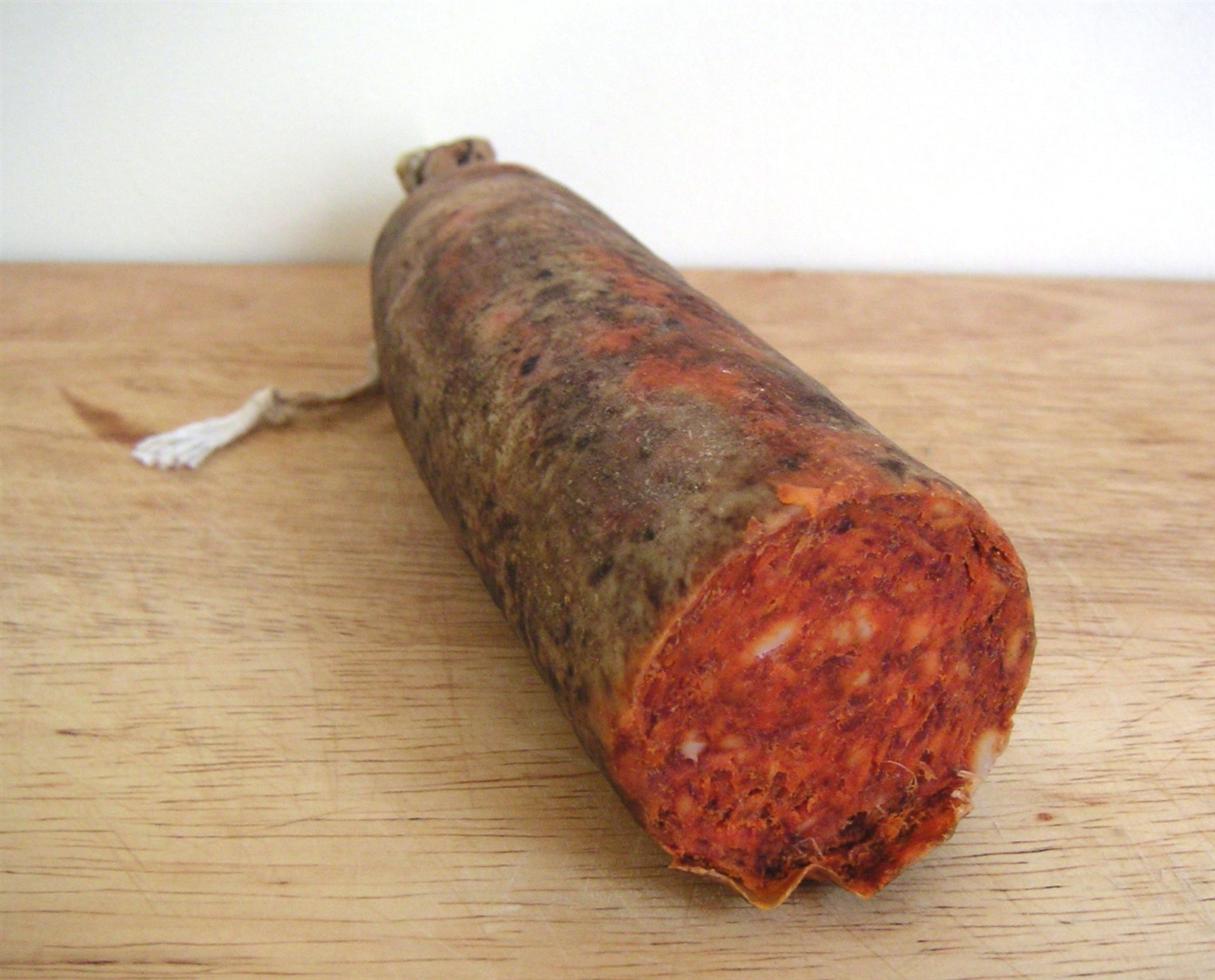
    Whole sobrassada de Mallorca sausages in a market crate, one cut open to show the paprika-red paste
    Sobrassada de Mallorca, sold whole and cut to order. It is the topping most islanders reach for first.

    The base is fixed; the toppings are where you make choices. The classics are cured ham, Mahon cheese from Menorca, anchovies and olives, and most cellers will offer a mixed board that gives you several at once.

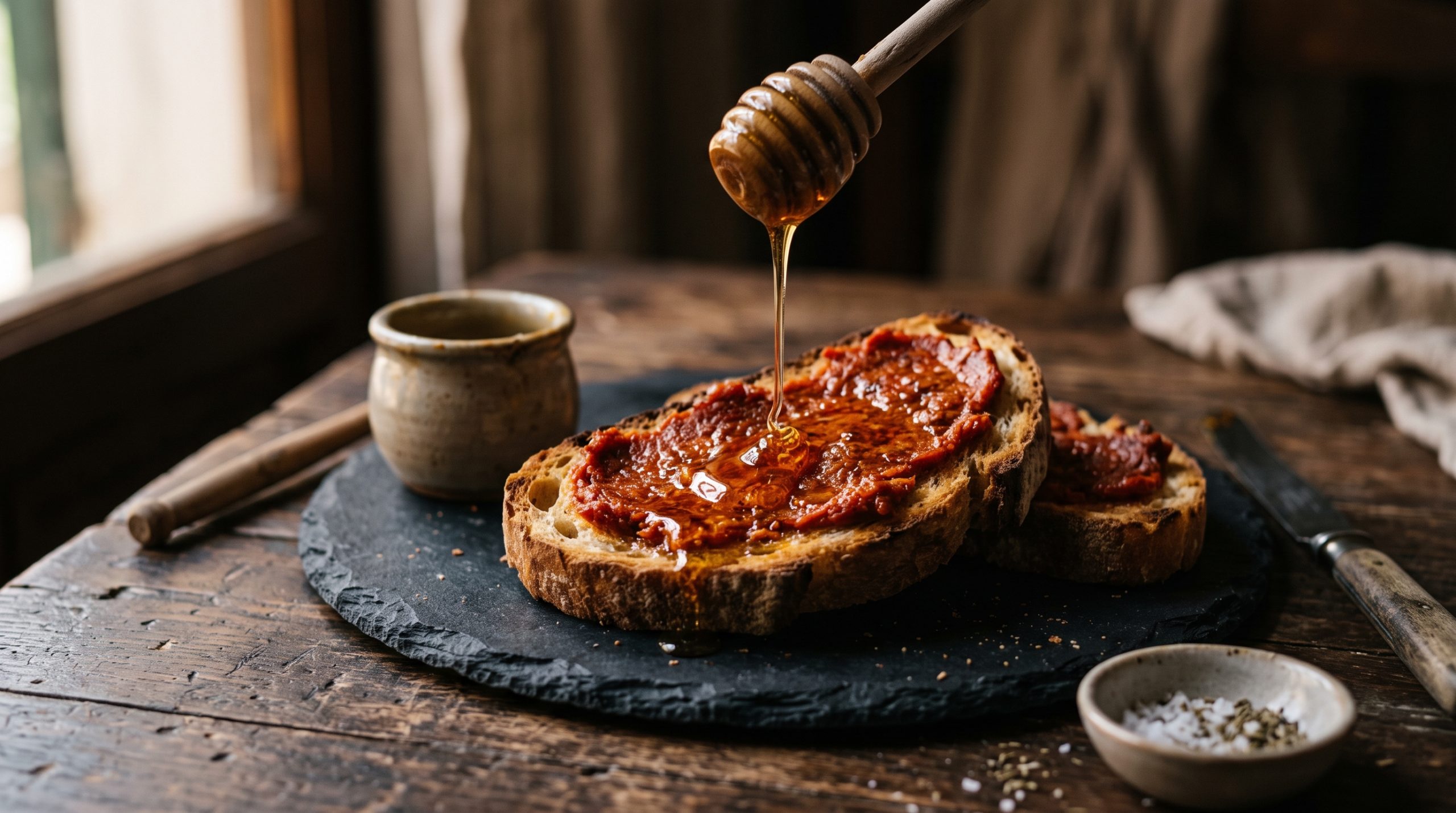
    Sobrassada is the most Mallorcan option and the one worth ordering at least once. It is a soft, spreadable, paprika-heavy cured sausage that goes onto the bread rather than sitting on it, and on the island it is often served with honey drizzled over the top. Our guide to what sobrassada is and how to buy it explains what to look for.

    Cheese deserves a word. Mahon is the default and it is genuinely good, particularly the semi-cured, but Mallorca also produces sheep and goat cheeses that rarely leave the island. If a celler offers a local cheese you do not recognise, take it. That is the whole argument for eating this dish here rather than reading about it.

    Where to Eat Pa amb Oli in Palma

    The traditional home of the dish is the celler, an old wine cellar turned restaurant, and Mallorca still has plenty of them. They are unglamorous, often windowless, lined with enormous barrels, and they serve the island’s heavy inland cooking alongside the pa amb oli board. In Palma they cluster in the older lanes rather than on the main squares.

    Barrel bodegas in the Old Town also serve it, usually as a smaller plate to go with a glass of wine rather than as a full board. That is the cheapest way to try it and the most casual. Our guide to the best tapas bars in Palma covers the bars most likely to do it well.

    One warning. Pa amb oli appears on almost every tourist menu in Palma, and a great deal of what is served near the cathedral is made with white bread and a sliced supermarket tomato. It is not that it will be inedible. It is that it will not be the dish, and you will conclude the island’s national food is unremarkable when the problem was the address.

    Make It Yourself, With the Right Tomato

    Our market tour buys the bread, the ramellet tomatoes and the sobrassada at Mercat de l’Olivar, then turns them into lunch in a hands-on tapas class. Six guests maximum.
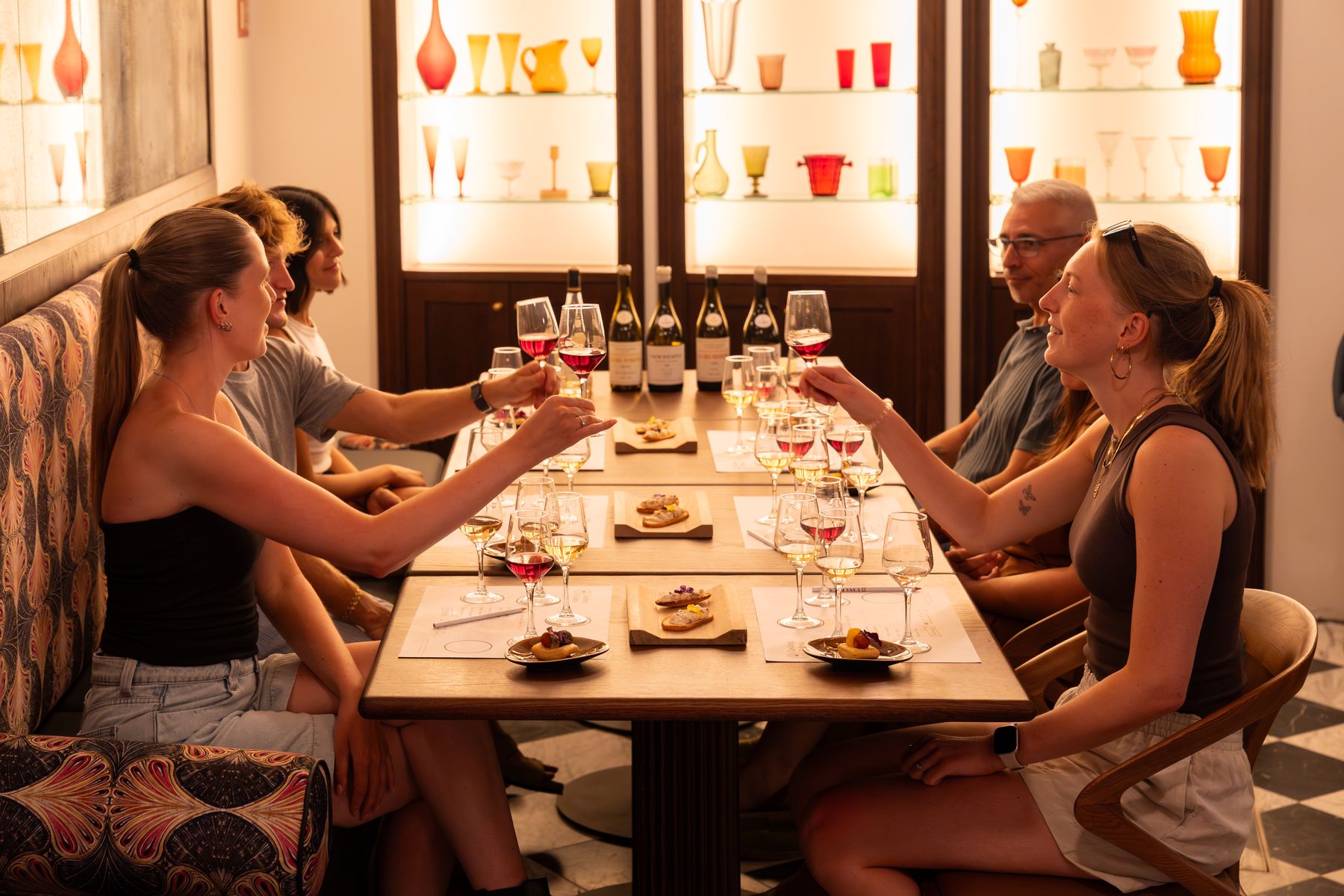
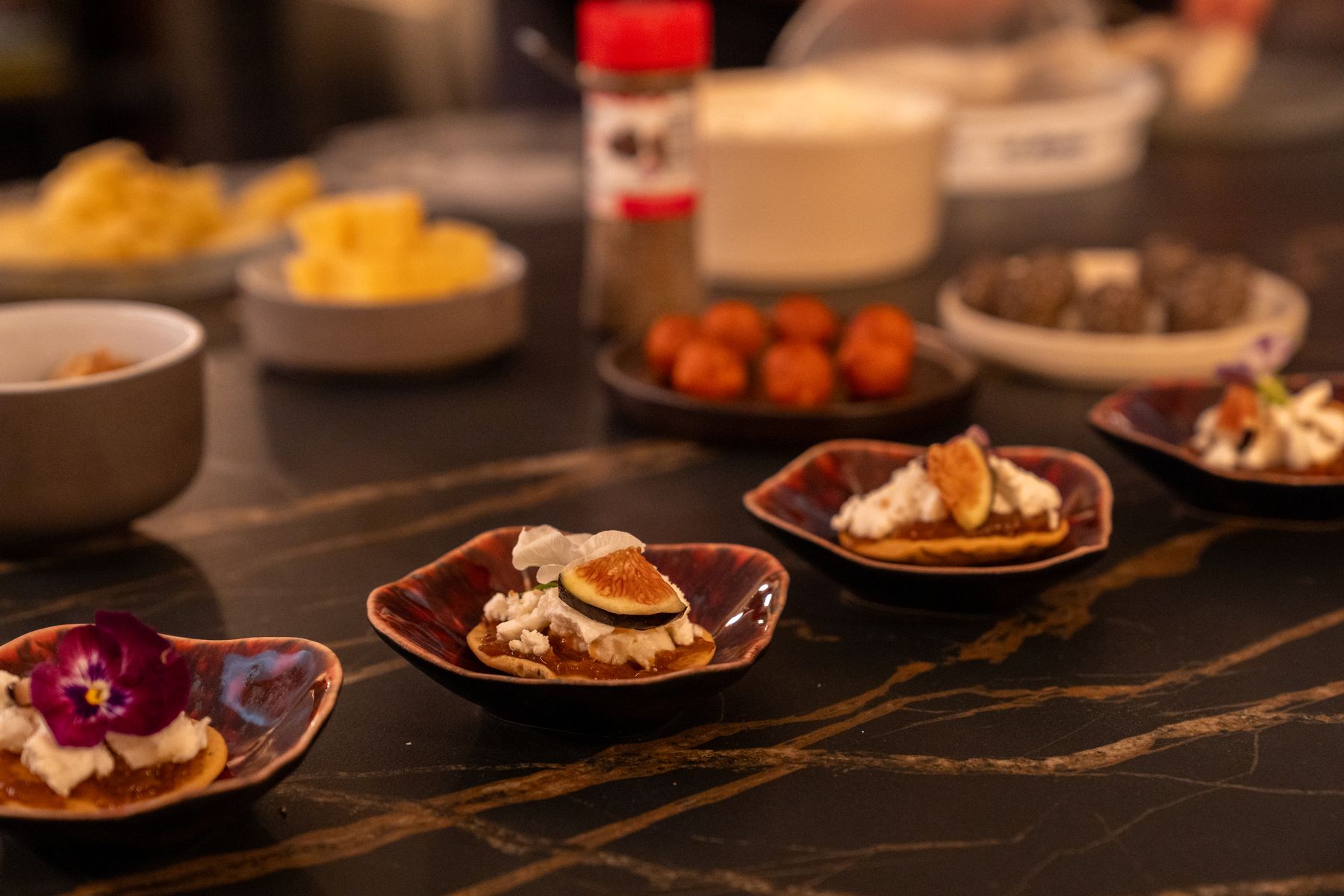
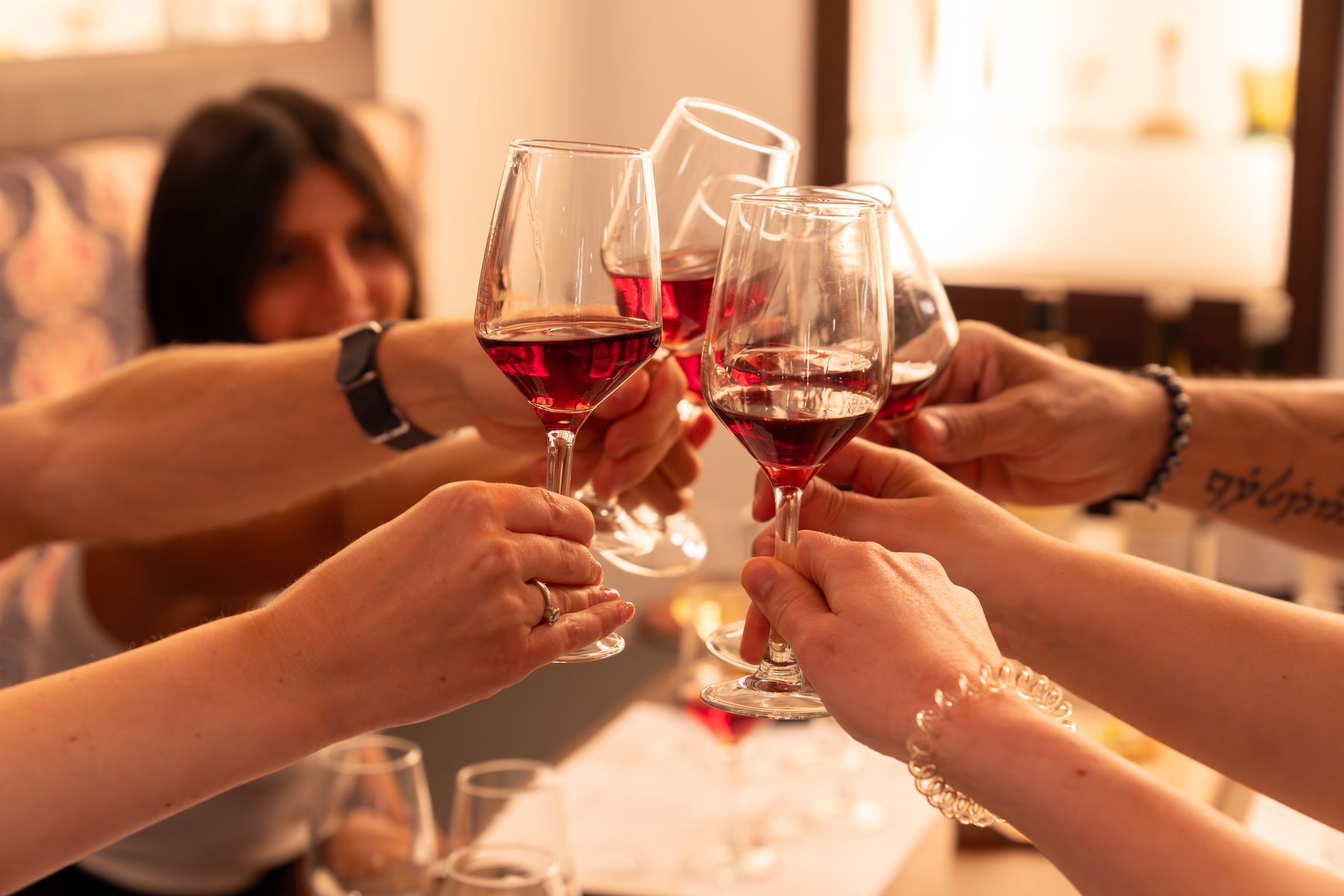
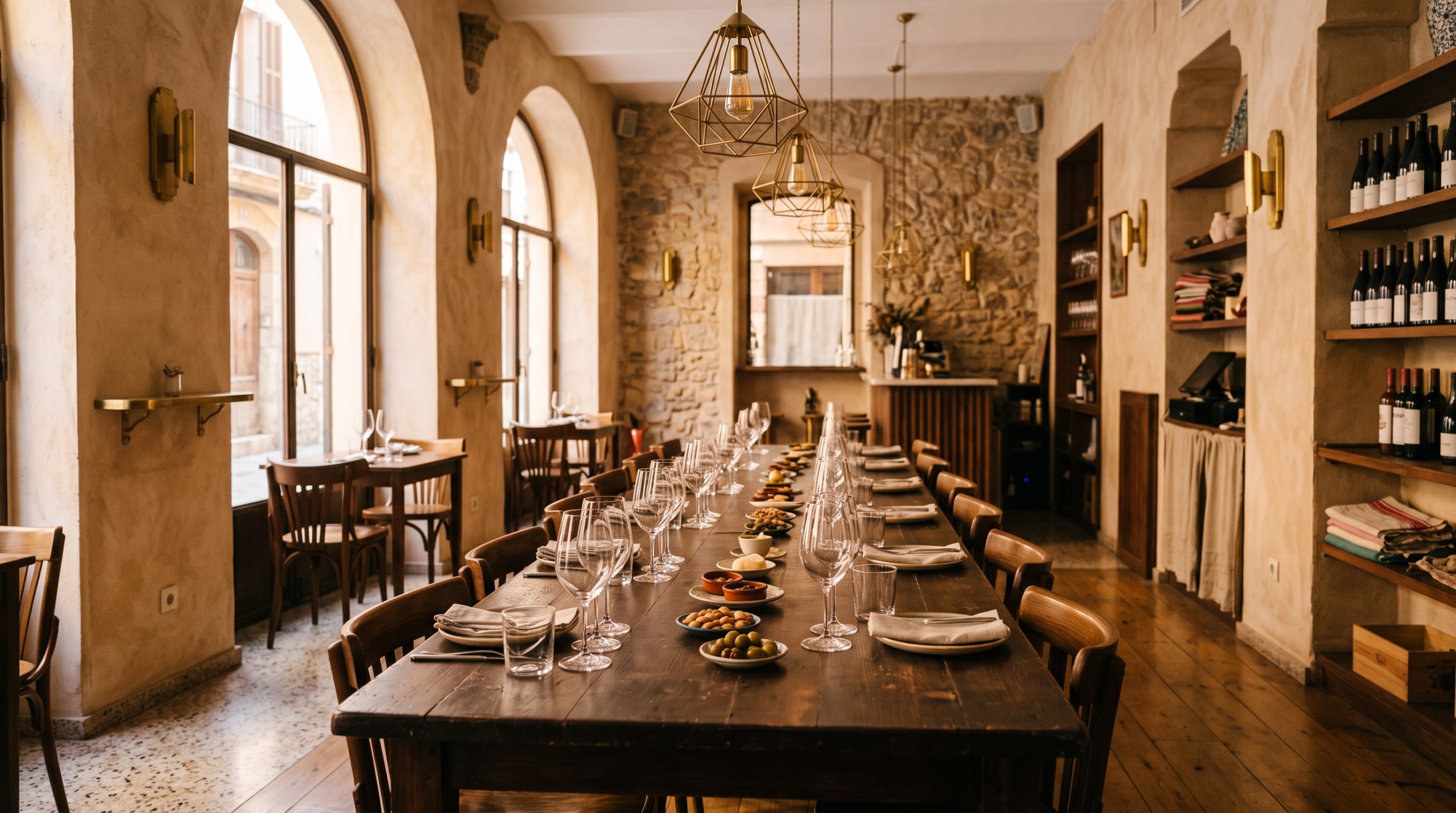
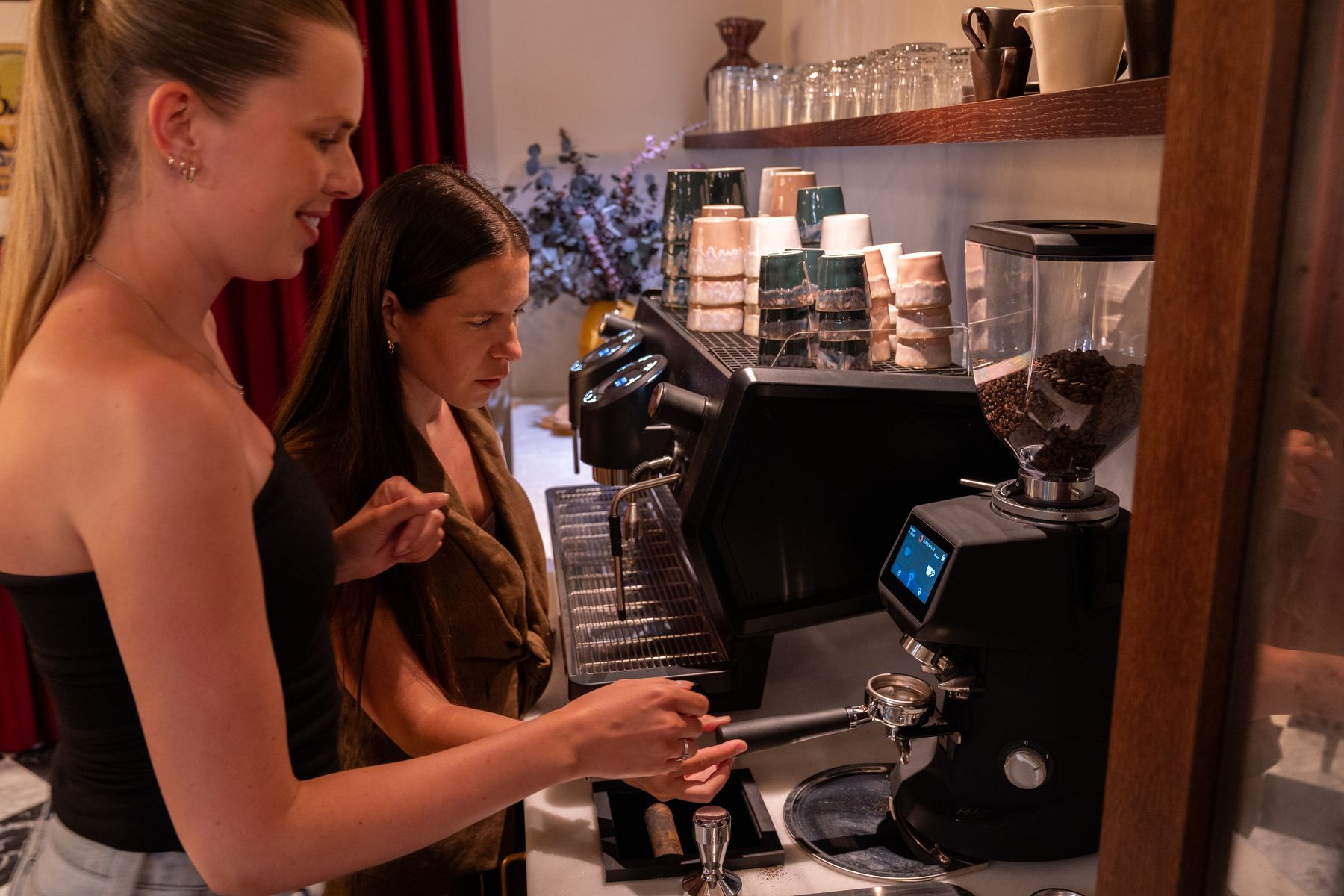
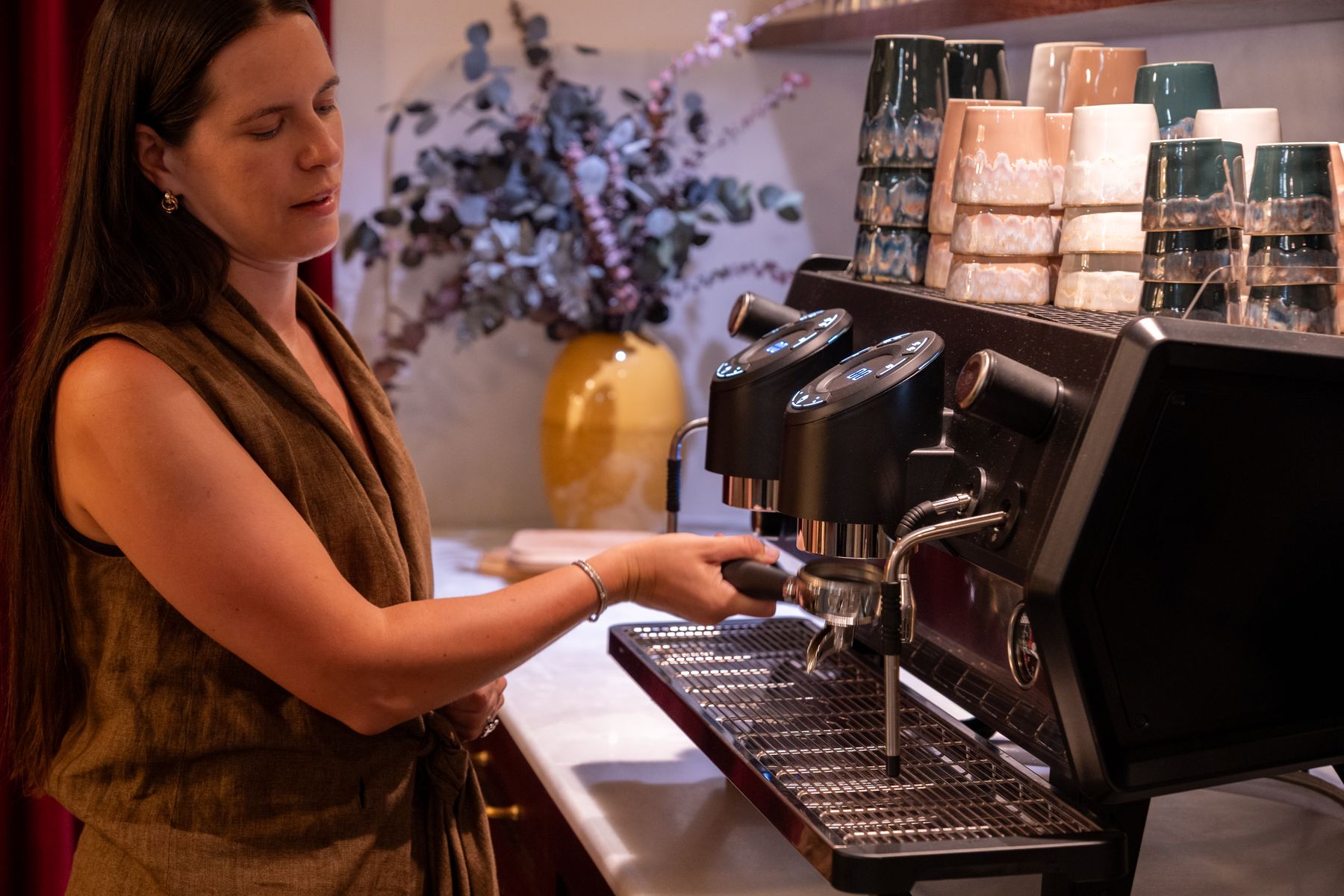
    Guests seated along the long table in the Tasting Palma tasting room in Palma Old TownA platter of Mallorcan tapas served in small dishes on a dark marble tableTwo tapas served on a wooden board beside a row of Mallorcan wine glassesA guest savouring a tapa during a Tasting Palma experienceGuests clinking glasses of Mallorcan red wine at a Tasting Palma tastingA barista drawing espresso at the machine during a speciality coffee tasting in Palma
    See the Market Tour

    When Mallorcans Eat Pa amb Oli

    It is not fixed to one meal, which is part of why it is so embedded here. It turns up as a light dinner, as an afternoon merienda, as something put on the table when people arrive unexpectedly, and as the thing a family eats on a Sunday evening when nobody wants to cook properly.

    It is not really a breakfast, and it is rarely a formal lunch. If you order it at nine in the morning nobody will refuse you, but you will be doing something slightly unusual. The natural windows are late afternoon from about five, and evening from eight onwards.

    It also carries a social function that is easy to miss. A pa amb oli board is designed to be shared and assembled at the table over an hour, with wine, while people talk. Ordering one for yourself and eating it quickly is perfectly possible and misses most of the point. This is food built around company.

    Seasonally it never goes away, which is the whole reason the ramellet tomato exists. An island that could not refrigerate needed a tomato that lasted through winter, and pa amb oli is what a Mallorcan kitchen could produce in February from things hanging in the pantry. That practicality is the dish’s real history, not the tourist-menu version.

    Making Pa amb Oli at Home

    You can make a respectable version anywhere, provided you accept that you will not have the ramellet tomato and adjust accordingly. Use the ripest, most intense small tomato you can find, and if it is watery, halve it and let it drain for a few minutes before rubbing.

    For bread, look for a dense country sourdough rather than a baguette or a soft white loaf. It needs an open crumb that will absorb oil and a crust with some resistance. Slice it thick, about a centimetre and a half, and consider toasting it lightly if it is very fresh.

    Use better oil than you think you need. This is the one component you can genuinely replicate outside Mallorca, and since the oil is a main ingredient rather than a seasoning, it is where the quality of your version is decided. If you brought a bottle of Oli de Mallorca home, this is what to open it for.

    Pa amb Oli: Frequently Asked Questions

    What Is Pa amb Oli?

    Pa amb oli means bread with oil in Mallorquín. It is a slice of Mallorcan brown bread rubbed with a ramellet tomato, drizzled generously with extra virgin olive oil and salted, then topped with cured ham, Mahon cheese, anchovies or sobrassada. In Mallorca it is a full meal rather than a side dish.

    What Is the Difference Between Pa amb Oli and Pa amb Tomàquet?

    The Catalan pa amb tomàquet uses ordinary ripe tomatoes on white bread and is served as a side or starter. Mallorcan pa amb oli uses the tomàtiga de ramellet specifically, uses darker pa moreno bread, and is a meal in its own right served as a board you assemble yourself.

    What Is a Tomàtiga de Ramellet?

    A small Mallorcan vine tomato with a thick, faintly bitter skin and concentrated flesh, grown specifically for storage. Hung in strings in a cool room it keeps for months. The tough skin is what lets you rub it into bread without the whole thing collapsing, which is why it is the correct tomato for pa amb oli.

    How Do You Eat Pa amb Oli?

    Rub the cut garlic on first if you want it, then press and drag the cut tomato across the bread until it is stained, add olive oil generously, salt it, and put the topping on last. Assemble one slice at a time and eat it straight away, because built bread goes soggy quickly.

    What Bread Is Used for Pa amb Oli?

    Pa moreno, the Mallorcan brown country loaf, traditionally baked without salt. That is why salt is added at the table. It should be dense with an open crumb, and ideally a day old rather than fresh, because slightly stale bread absorbs oil better than a warm loaf does.

    What Do You Put on Top of Pa amb Oli?

    Cured ham, Mahon cheese, anchovies and olives are the classics, and most cellers offer a mixed board. Sobrassada is the most Mallorcan choice, spread onto the bread and often served with honey. Local sheep and goat cheeses are worth taking if a restaurant offers one you do not recognise.

    Where Do You Eat Pa amb Oli in Palma?

    In a celler, the old wine cellar turned restaurant, which is the traditional home of the dish, or in a barrel bodega in the Old Town as a smaller plate with a glass of wine. Avoid the versions on tourist menus near the cathedral, which are often made with white bread and a sliced salad tomato.

    Can You Make Pa amb Oli Outside Mallorca?

    Yes, with adjustments. You will not find ramellet tomatoes, so use the ripest small intense tomato available and let it drain if watery. Use a dense country sourdough rather than white bread, slice it thick, and use the best olive oil you have. The oil is a main ingredient here, not a seasoning.

    Learn the Dish Where It Belongs

    Shop Mercat de l’Olivar with a guide, then make Mallorcan tapas with a chef in Palma Old Town. Small groups of six, from €149 per person.

    Book the Market Tour Ask Us a Question

    Photographs of ramellet tomatoes by Rotget (CC BY-SA 4.0) and of sobrassada by Juan Emilio Prades Bel (CC BY 4.0), and of whole sobrassada by Slastic (public domain), via Wikimedia Commons.

  • Mallorca Wine Guide: Grapes, Regions and Where to Taste

    Mallorca Wine Guide: Grapes, Regions and Where to Taste

    At A Glance

    Mallorca wine is built on native grapes almost nobody outside the island has heard of, which is exactly why it is worth drinking here rather than at home.

    • Two protected regions: DO Binissalem, the oldest, and DO Pla i Llevant in the south-east.
    • Manto Negro is the signature red. Binissalem reds must contain at least 30 per cent of it.
    • Prensal Blanc, also called Moll, is the white. It must be at least 50 per cent of a Binissalem white.
    • Callet is the other great red, and the star of Pla i Llevant.
    • Almost none of it is exported. A bottle you like here is difficult to buy at home.

    Mallorca wine has a problem that is also its best feature: hardly any of it leaves the island. Production is small, domestic demand absorbs most of it, and the grapes are varieties that mean nothing on an export label. The result is that most visitors arrive without a single reference point, order the house red because it is cheap, and go home never knowing they drank something that exists almost nowhere else.

    That is a shame, because the island has been making wine for roughly two thousand years and is currently in the middle of the most interesting period it has had in a century. Young winemakers have gone back to native grapes that were nearly abandoned, and the wines coming out of the two protected regions now are genuinely worth paying attention to.

    This guide covers the two wine regions, the grapes worth knowing by name, what to order in a Palma bar, and where to taste properly. If spirits are more your thing, our Mallorca gin guide covers the island’s distilleries.

    Want to taste the island’s recovered grapes without driving to the vineyards? Our 90-minute wine tasting with tapas, led by a fifth-generation winemaker, runs in Palma Old Town from €49.

    See the wine tasting

    Mallorca Wine Regions: Binissalem and Pla i Llevant

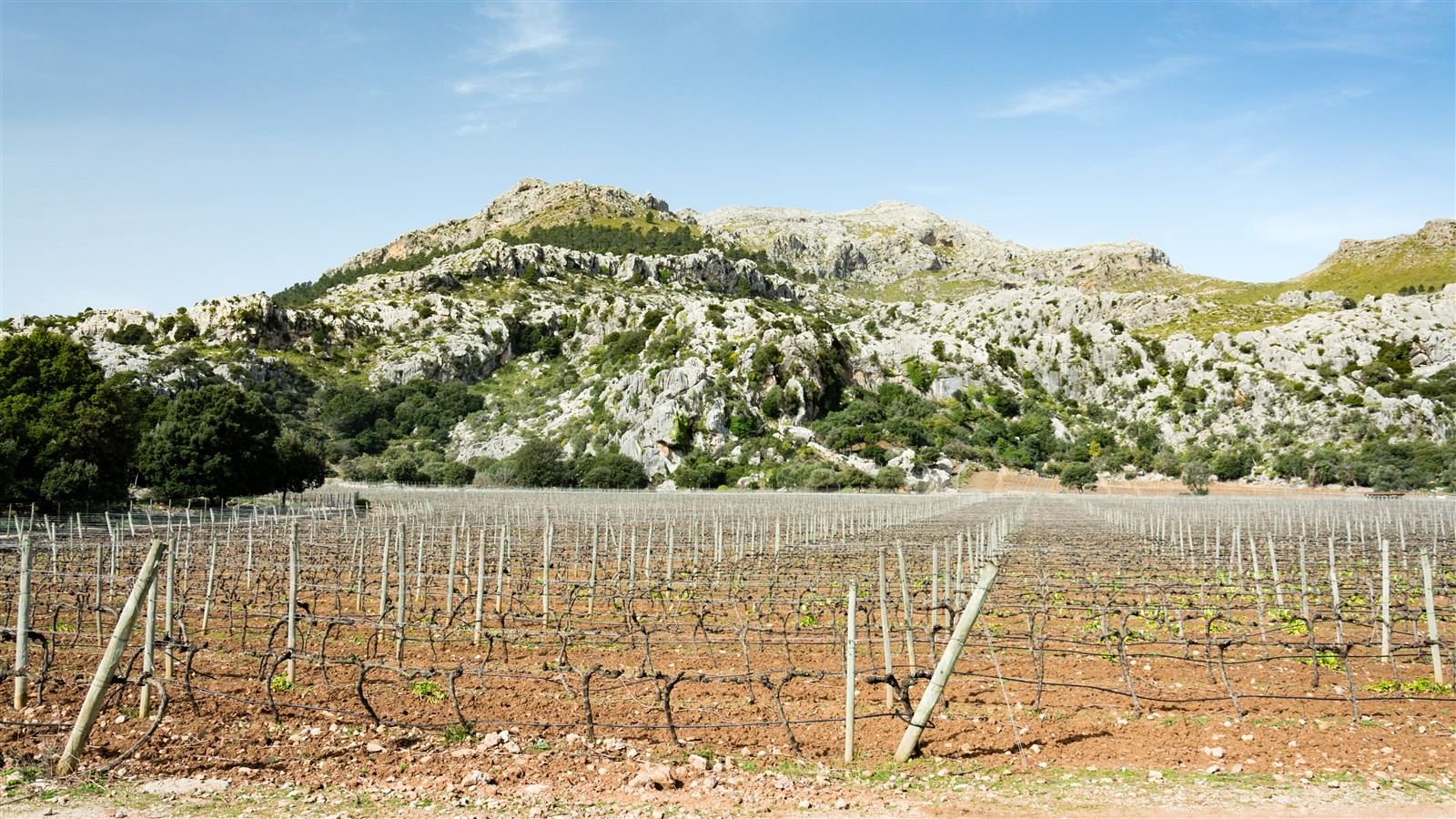
    Rows of pruned vines on red soil below the limestone ridges of the Serra de Tramuntana, Mallorca
    Vines on the island’s red soil, with the Tramuntana behind them sheltering the growing regions inland.

    Mallorca has two Denominaciones de Origen, the Spanish system of protected wine regions, and they sit in different parts of the island with different characters.

    DO Binissalem is the older of the two and the one most people mean when they talk about Mallorca wine. It centres on the town of Binissalem, about twenty-five minutes inland from Palma, on the plain between the Serra de Tramuntana and the sea. The mountains shelter it from the northern weather, the soils are limestone and clay, and the reds it produces are warm and gently spiced rather than heavy.

    DO Pla i Llevant was recognised in the 1990s and covers the flatter south-east of the island, running towards Felanitx and Manacor. The name translates roughly as flat and eastern, which is unglamorous and accurate. It is the larger of the two regions in area and gives more freedom to producers, which has made it the more experimental of the pair.

    There is a third category worth knowing: Vi de la Terra Mallorca. It is a broader designation with looser rules, and a great many of the island’s more adventurous wines sit under it precisely because their producers did not want to work inside the DO restrictions. Do not read it as lower quality. Some of the best bottles on the island carry it.

    Mallorca Wine Grapes Worth Knowing

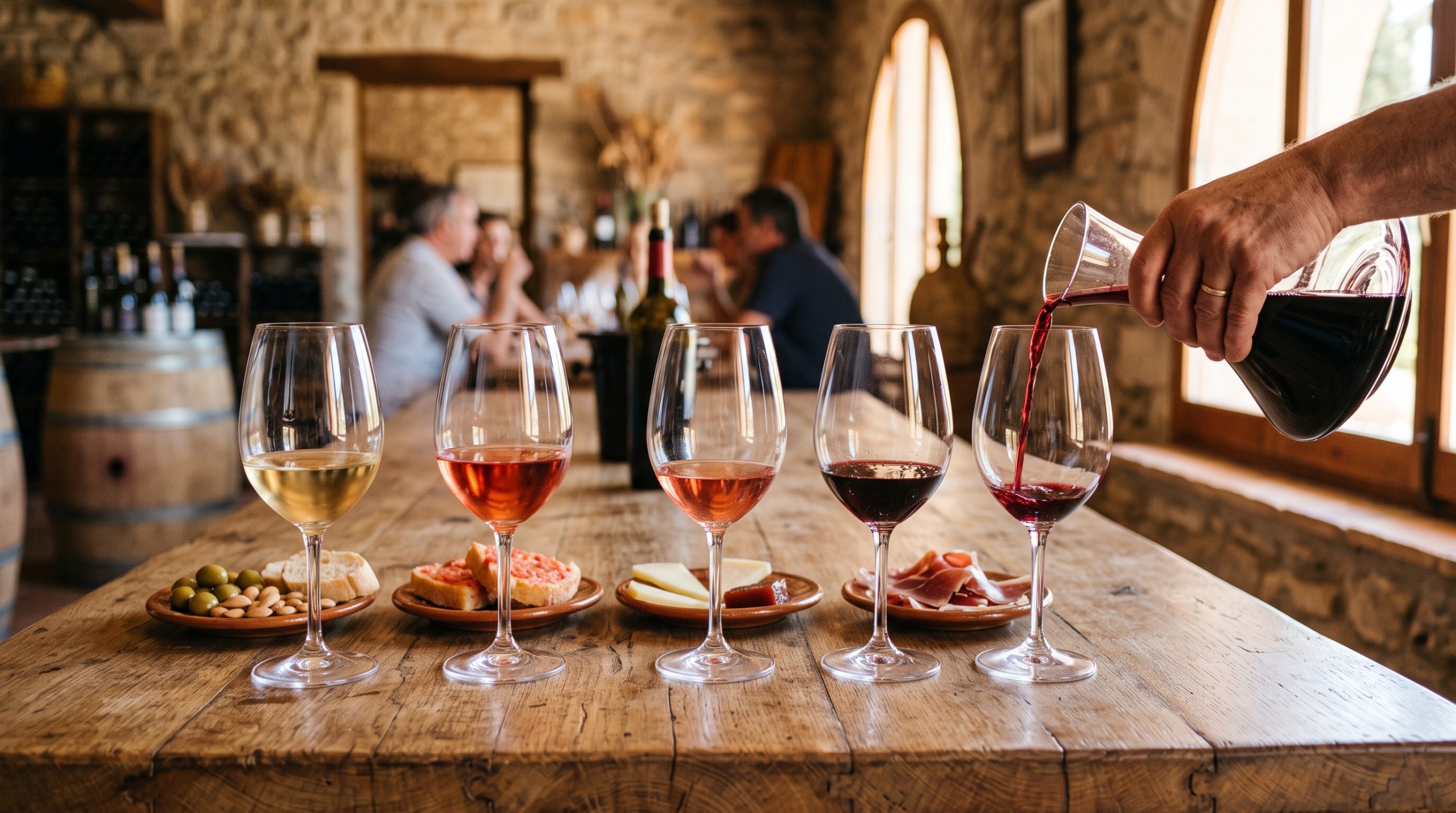
    A flight of five Mallorcan wines paired with small tapas plates
    A flight is the fastest way to understand the island’s grapes side by side.

    Four names will get you through almost any Mallorcan wine list. Learn them and you can order confidently anywhere on the island.

    GrapeColourWhere it dominatesWhat it tastes likeRule to know
    Manto NegroRedDO BinissalemWarm, gently spiced, pale, soft tanninsMinimum 30% of a Binissalem red
    CalletRedDO Pla i LlevantEarthy, structured, pale, low tanninThe star grape of the east
    Prensal Blanc (Moll)WhiteDO BinissalemFresh, easy, citrus and soft stone fruitMinimum 50% of a Binissalem white
    FogoneuRedPla i Llevant, blendsLight, high acid, often in rosésRarely bottled alone
    The four native varieties that define Mallorca wine.

    Manto Negro is the one to start with. It produces reds that are noticeably paler than a Rioja or a Ribera and considerably softer in tannin, which surprises people expecting something heavy from a hot island. The character is warm and gently spiced rather than jammy. Binissalem regulations require at least thirty per cent of it in a red, which is why the region tastes coherent.

    Callet is the other great red and the reason Pla i Llevant is worth exploring separately. It brings earthiness and structure where Manto Negro brings warmth, and it also produces wines of pale colour and low tannin. Winemakers who want to make something serious and Mallorcan tend to reach for Callet.

    Prensal Blanc, which you will also see written as Moll, is the island’s workhorse white. It is fresh, uncomplicated and built for the food here: grilled fish, pa amb oli, anything with olive oil in it. It must make up at least half of a Binissalem white. It will not change your life and it is not trying to.

    Fogoneu is the fourth name worth carrying. It is light, high in acid and rarely bottled on its own, appearing instead in blends and in the island’s rosés, which are considerably better than the average Mediterranean holiday pink. If a Mallorcan rosé tastes fresher and less confected than you expected, Fogoneu is usually why.

    You will also meet international varieties on island wine lists. Cabernet Sauvignon, Syrah, Merlot and Chardonnay are all grown here, and some of them are made well. They are not the reason to drink Mallorcan wine. If you have a limited number of glasses on a short trip, spend them on the grapes you cannot get anywhere else.

    One quirk worth explaining: the pale colour of Mallorcan reds catches people out. A Manto Negro in the glass can look closer to a dark rosé than to a Rioja, and visitors sometimes assume it has been watered down or is somehow lesser. It has not and it is not. Low colour extraction and soft tannins are simply what these grapes do, and it is the reason the wines work so well with the island’s fatty, paprika-heavy cooking.

    Why Mallorca Wine Nearly Disappeared

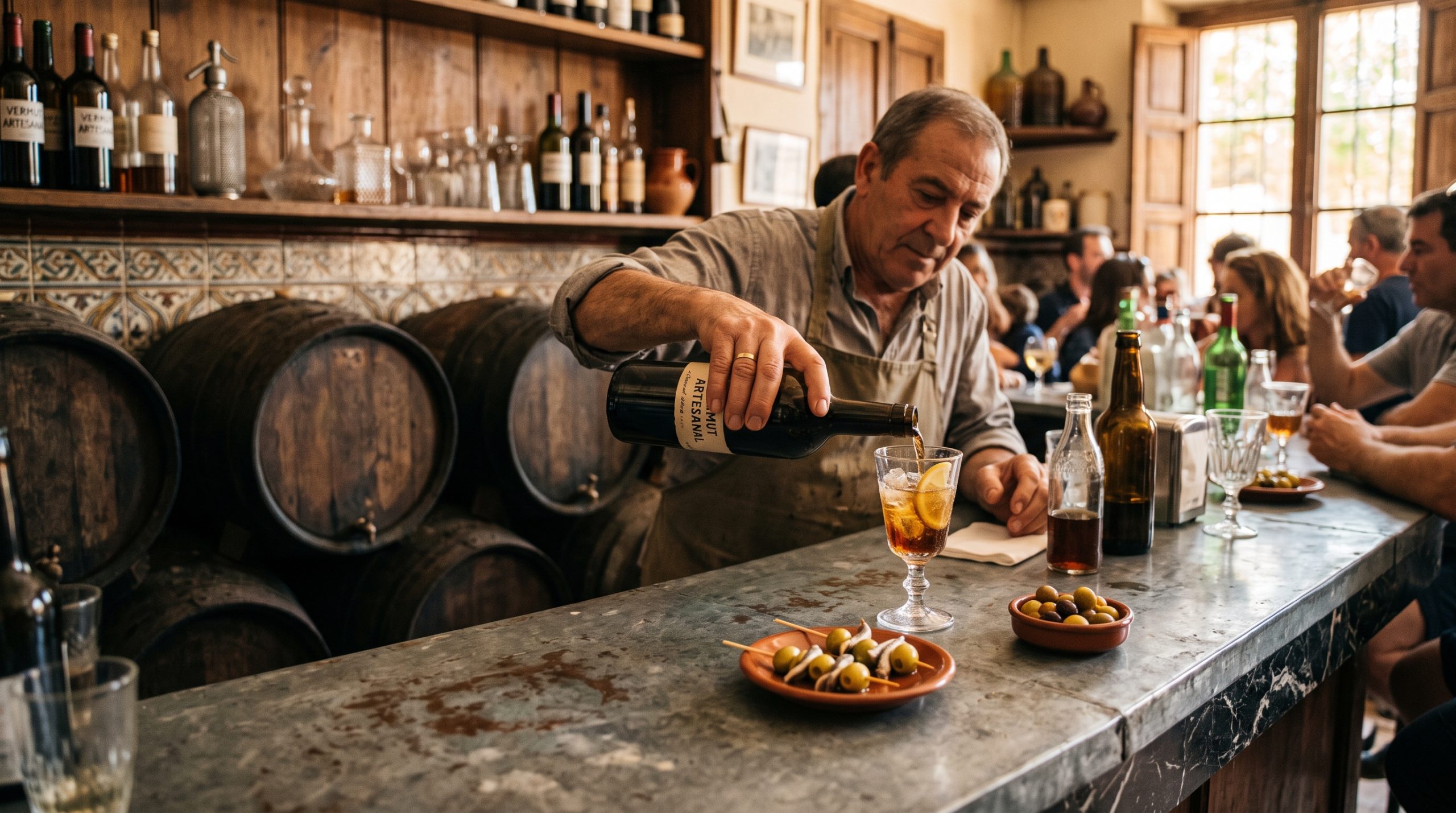
    Vermouth being poured at a traditional Palma bodega counter lined with oak wine barrels
    Barrel wine in a Palma bodega, the format most islanders grew up drinking.

    Mallorca had a large and prosperous wine industry in the nineteenth century, helped considerably by phylloxera devastating French vineyards and creating enormous demand. Then phylloxera arrived here too, in the 1890s, and the industry collapsed almost entirely.

    What replaced the vines was almonds. Enormous areas of the island were replanted, which is why the February almond blossom is now one of Mallorca’s signature sights and why so few old vineyards survive. For most of the twentieth century Mallorcan wine meant cheap bulk production drunk locally from a barrel and taken no more seriously than that.

    The recovery is recent. DO Binissalem was recognised in 1991 and Pla i Llevant followed later that decade, and the past twenty years have seen a genuine revival, driven partly by outside investment and partly by a generation of local winemakers who decided the native grapes were worth rescuing rather than replacing with Cabernet. Which is why the interesting bottles are all quite young as businesses, even where the vines are old.

    How to Order Mallorca Wine in Palma

    The Tasting Palma tasting room set with wine glasses and small plates
    Tasting several side by side is how the grapes start to separate.

    The single most useful sentence is: what Mallorcan wines do you have by the glass? Almost every decent bar in Palma will have two or three, and asking signals that you want the local thing rather than the Rioja everybody defaults to. In a barrel bodega the house wine is usually Mallorcan by default and costs two to three euros.

    Expect prices to be reasonable rather than cheap. A good bottle of Binissalem red in a Palma restaurant sits somewhere around twenty-five to forty euros, and by the glass you are looking at four to seven. That is more than a glass of mainland Spanish wine and less than the equivalent quality from Rioja.

    Pair it the way the island does. Manto Negro handles sobrassada and roast lamb without being overwhelmed. Prensal Blanc goes with everything that comes out of the sea and with pa amb oli. Our guide to the best tapas bars in Palma covers the bars most likely to have island bottles open.

    Ordering Mallorca Wine: A Cheat Sheet

    • Want a safe red: a Binissalem with Manto Negro. Warm, soft, food-friendly.
    • Want something more serious: a Callet from Pla i Llevant.
    • Eating fish: Prensal Blanc, also listed as Moll.
    • Hot afternoon: a Mallorcan rosé, often built on Fogoneu.
    • On a budget: house wine from the barrel in a bodega, €2–€3.50 a glass.
    • Buying a bottle home: pick something under Vi de la Terra, which rarely reaches export.

    Where to Taste Mallorca Wine Without a Car

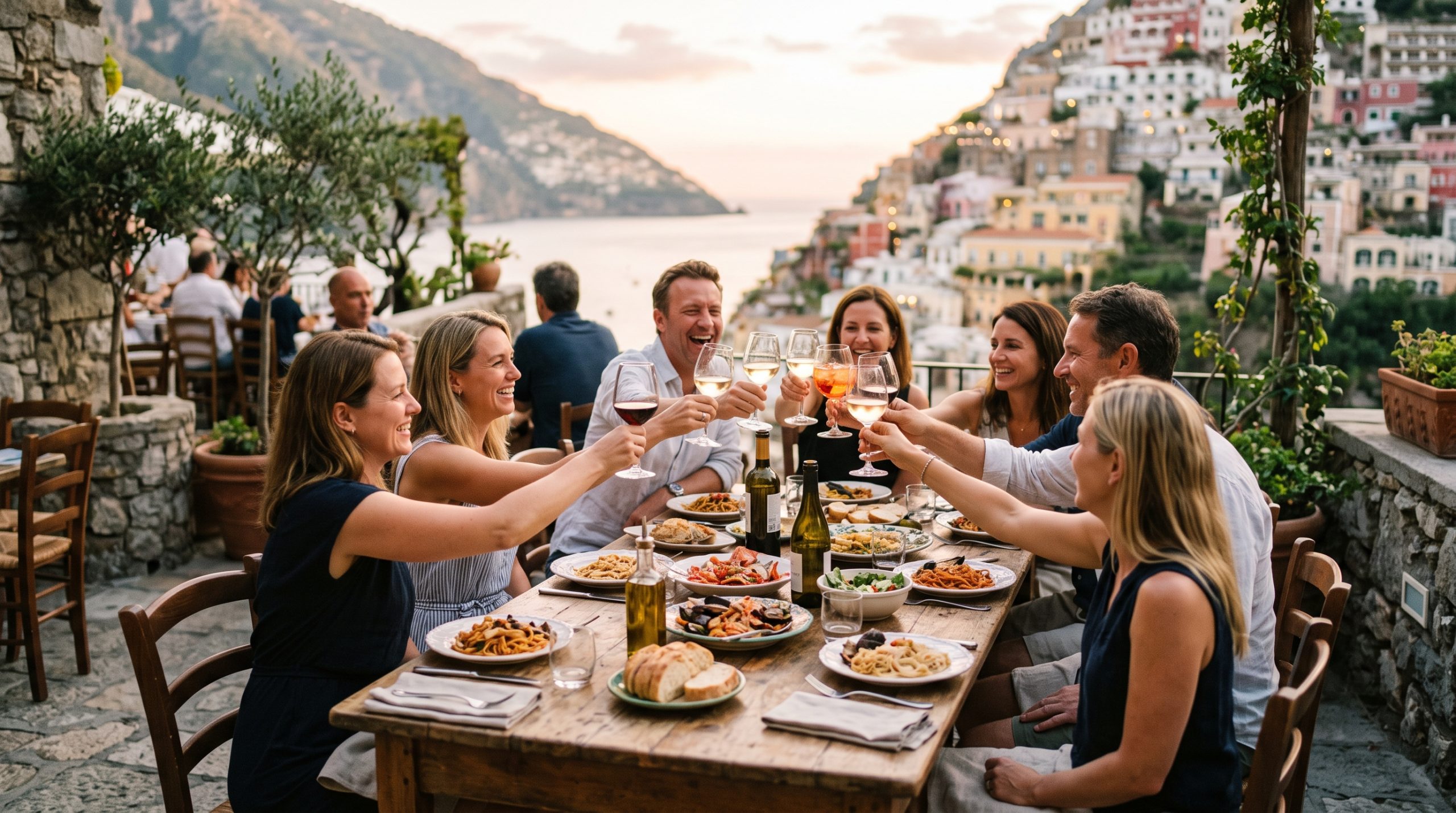
    A small group raising glasses in a toast around a long shared table
    A guided tasting removes the two problems: the driving and the guessing.

    Visiting the bodegas themselves is the romantic option and it comes with a practical problem: the vineyards are inland, the public transport is thin, and somebody has to drive. Binissalem is reachable by train from Palma, which makes it the realistic choice for a self-guided winery day, but the individual estates are spread out once you arrive.

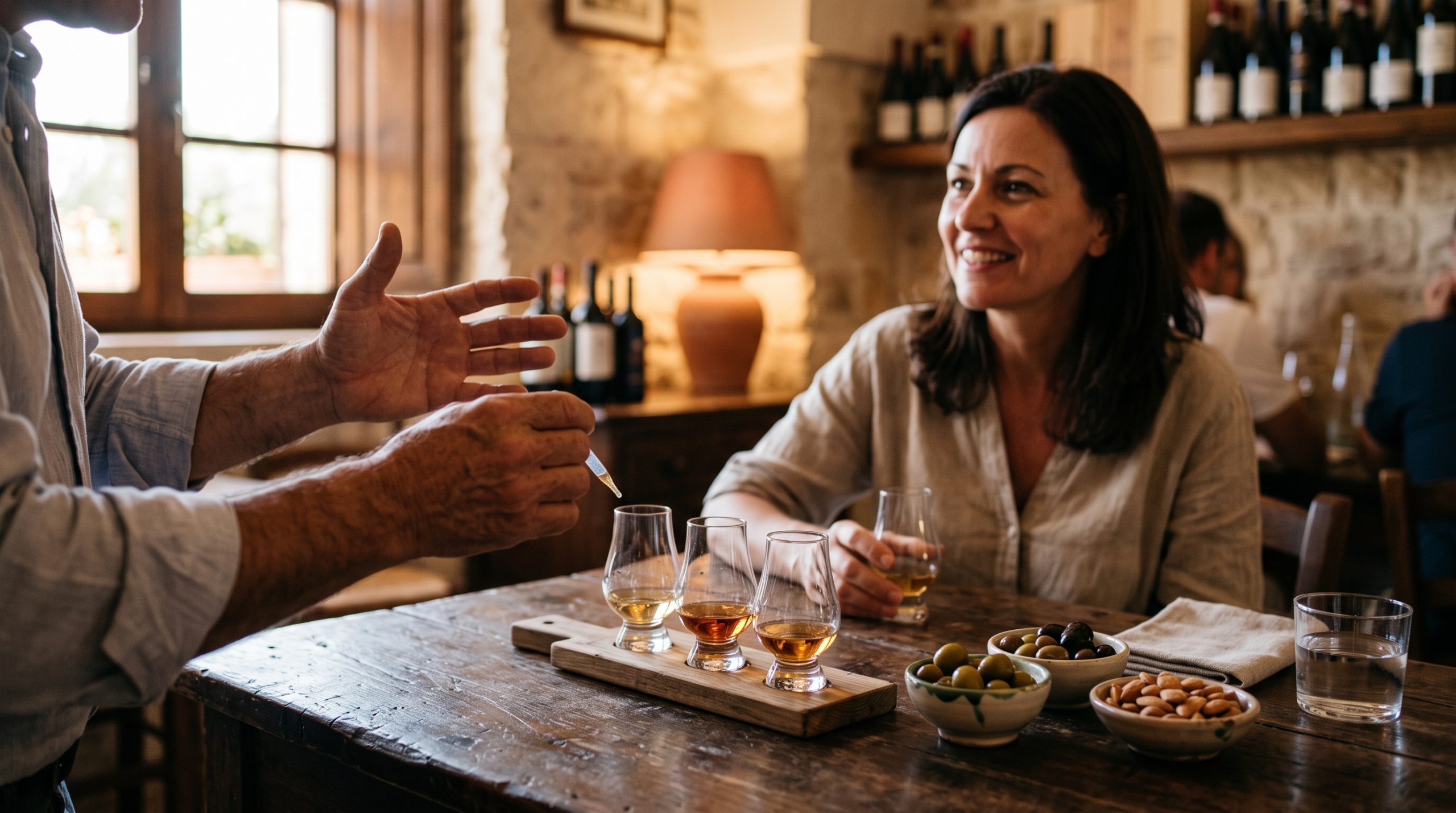
    The alternative is to taste in Palma. A structured tasting in the city puts five or six island wines in front of you in ninety minutes, with someone who can explain what separates Manto Negro from Callet and why the whites taste the way they do. You learn more in that time than in a day of driving between two estates, and nobody has to stay sober.

    Either way, taste before you buy. Mallorcan wine is not exported in volume, so the bottle you carry home is likely to be one you cannot replace. That is a good reason to be sure you actually like it rather than buying on the strength of a label at the airport.

    Taste Five Mallorcan Wines in Ninety Minutes

    Our wine tasting runs in Palma Old Town with a fifth-generation winemaker, pouring rare recovered island grapes with tapas pairings. Six guests maximum, from €49 per person.

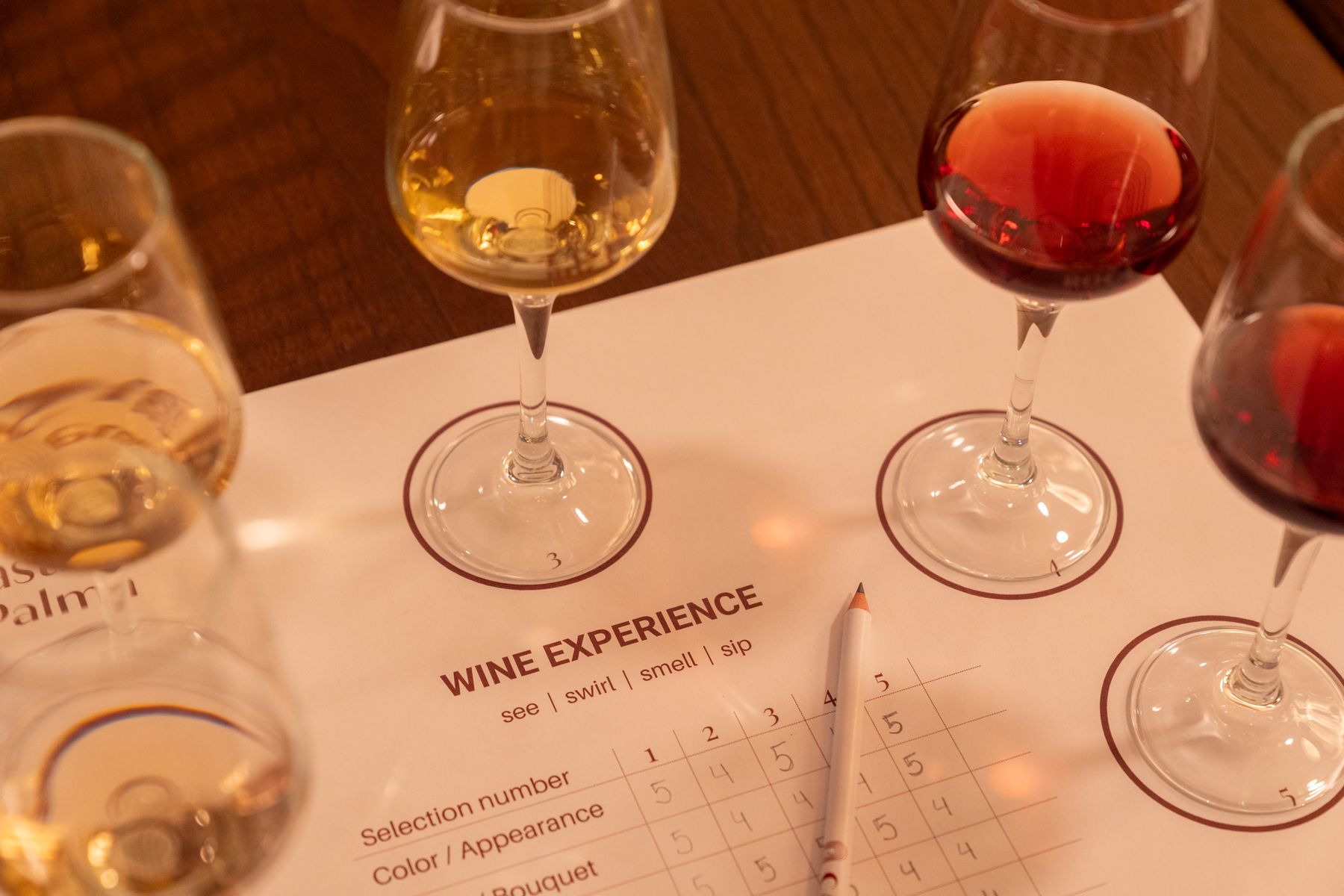
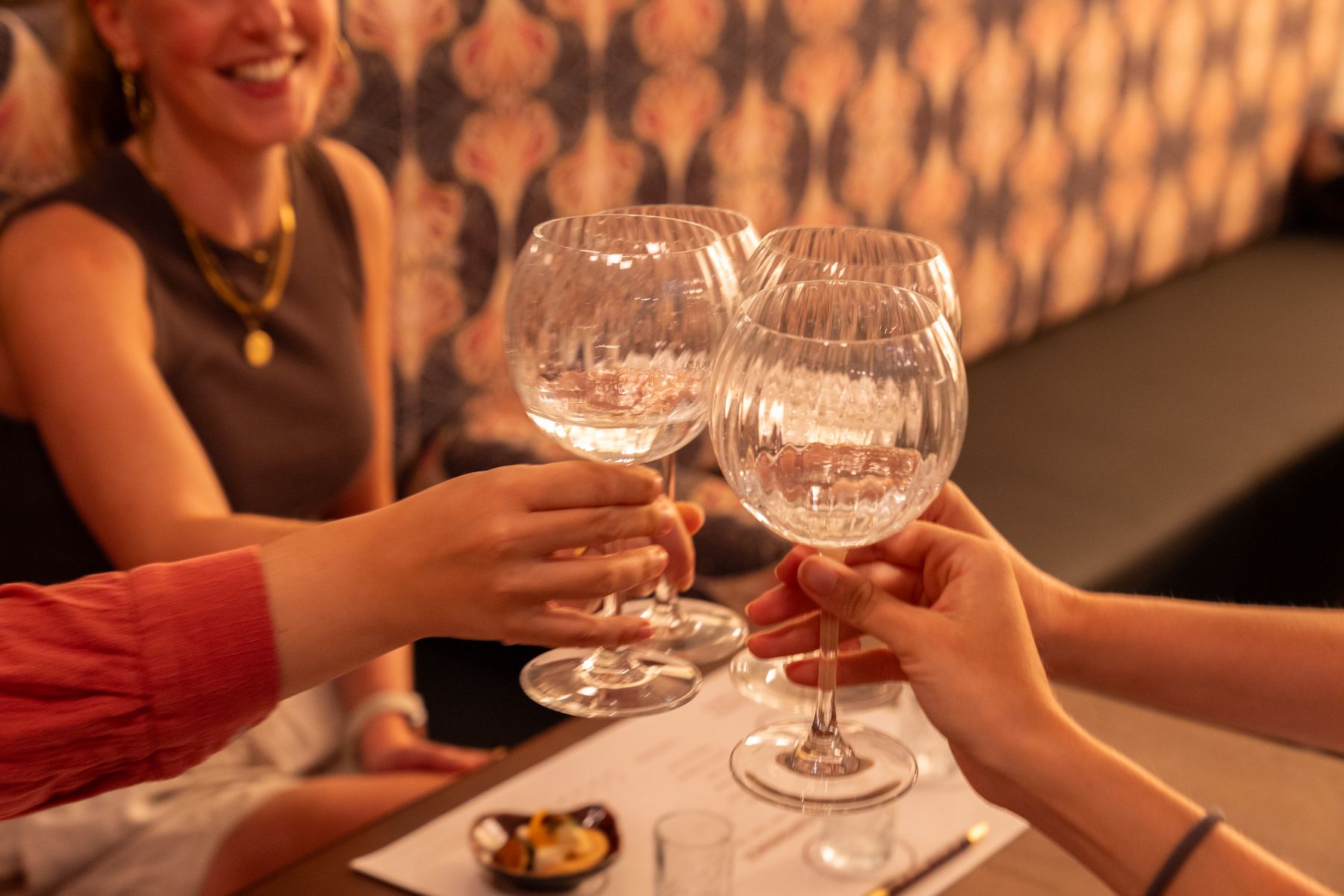
    Guests seated along the long table in the Tasting Palma tasting room in Palma Old TownGuests clinking glasses of Mallorcan red wine at a Tasting Palma tastingA wine tasting mat with a white and a red Mallorcan wine set on the marked circlesTwo tapas served on a wooden board beside a row of Mallorcan wine glassesA platter of Mallorcan tapas served in small dishes on a dark marble tableA guest savouring a tapa during a Tasting Palma experience
    See the Wine Tasting

    Mallorca Wine and Food: What to Drink With What

    Island wine evolved alongside island food, which makes the pairings unusually straightforward. You do not need to think hard: the things that grow together generally go together, and Mallorcan cooking is built on olive oil, pork, tomatoes and fish.

    Manto Negro with sobrassada is the classic. The wine’s softness handles the paprika and the fat without fighting it, where a big tannic red would flatten both. The same red works with arròs brut, the dark soupy Mallorcan rice, and with roast lamb or suckling pig.

    Prensal Blanc belongs with anything from the water and with pa amb oli, the bread rubbed with tomato and dressed with oil that appears on every table. For a full run through the island’s dishes and where to eat them, our Palma food guide is the place to start.

    When to Visit for Mallorca Wine

    Harvest runs from roughly late August into early October, earlier than most of mainland Europe because the island is hot and the grapes ripen fast. If you want to see the wineries working rather than simply pouring, September is the month. Several estates run harvest events, and the atmosphere across Binissalem in particular changes completely.

    The trade-off is that harvest is also when winemakers are least available. A visit in May or October gets you more of the owner’s attention and a calmer tasting, which for most visitors is the better experience. Spring also gives you the countryside at its best, which matters if you are driving out to the estates.

    Binissalem holds a wine festival in late September, the Festa des Vermar, which is worth planning around if the dates line up. It is a genuine local celebration rather than a tourist event, complete with grape-throwing, and it is the one time of year the island’s wine culture is visible on the street rather than inside a bodega.

    Out of season, nothing stops. Tastings in Palma run year-round and the city’s wine bars are, if anything, better in winter when they are full of residents rather than visitors. Mallorca wine is not a summer-only proposition, and a January tasting is often the more interesting one.

    Buying Mallorca Wine to Take Home

    Buy in the city rather than at the airport. Palma’s specialist wine shops and the market stalls carry a far better range at better prices, and the staff can tell you what a bottle actually is rather than pointing at a shelf.

    Wine has to go in hold luggage, which limits most people to two or three bottles and means wrapping them properly. If you are travelling hand-luggage only, this is the one Mallorcan product you genuinely cannot take, and it is worth knowing before you fall in love with something at a tasting.

    Write down what you bought. Mallorcan producers are small and their labels are not memorable to a foreign eye, and it is remarkably easy to get home with a bottle you love and no way to find it again. A photograph of the label at the point of purchase solves the problem entirely.

    Mallorca Wine: Frequently Asked Questions

    What Is Mallorca Wine Known For?

    Native grapes that grow almost nowhere else, principally the red Manto Negro and Callet and the white Prensal Blanc. The reds are paler and softer in tannin than mainland Spanish reds, which surprises people. Very little is exported, so a bottle you enjoy here is difficult to buy at home.

    What Are the Mallorca Wine Regions?

    Two protected regions. DO Binissalem is the older, on the plain about 25 minutes inland from Palma, built around Manto Negro. DO Pla i Llevant was recognised in the 1990s and covers the flatter south-east, where Callet is the star grape. A third designation, Vi de la Terra Mallorca, has looser rules and covers many of the island’s more experimental wines.

    What Is Manto Negro?

    Mallorca’s signature red grape, grown mainly in DO Binissalem, where regulations require it to make up at least 30 per cent of a red wine. It produces wines that are pale in colour, low in tannin and warm and gently spiced in character, which makes them far more food-friendly than their alcohol level suggests.

    Where Can You Do a Mallorca Wine Tasting?

    Either at the bodegas inland or at a structured tasting in Palma. The estates are spread out and someone has to drive, though Binissalem is reachable by train. A tasting in the city puts five or six island wines side by side in about 90 minutes, which is the faster way to learn the grapes.

    How Much Does Mallorca Wine Cost?

    A good bottle of Binissalem red in a Palma restaurant is roughly 25 to 40 euros, and 4 to 7 euros by the glass. House wine drawn from the barrel in a traditional bodega is 2 to 3.50 euros a glass. Expect island wine to cost a little more than mainland Spanish equivalents.

    What Food Goes With Mallorca Wine?

    Manto Negro with sobrassada, arròs brut, roast lamb or suckling pig, because its softness handles paprika and fat without overwhelming them. Prensal Blanc with grilled fish, seafood and pa amb oli. The island’s wines evolved alongside its cooking, so the obvious pairings are usually the right ones.

    Why Is Mallorca Wine Hard to Find Abroad?

    Production is small and domestic demand absorbs most of it, so very little is exported. The grape names also mean nothing on an international label, which gives producers little incentive to chase foreign markets. It is the main reason to buy a bottle while you are here rather than intending to find it later.

    Can You Take Mallorca Wine Home on a Plane?

    Only in hold luggage, which in practice limits most people to two or three well-wrapped bottles. If you are travelling with hand luggage only, wine is the one Mallorcan product you cannot carry, so buy cured goods instead. Buy in the city rather than at the airport, where range and prices are both worse.

    Drink the Grapes You Cannot Buy at Home

    Ninety minutes, five Mallorcan wines, tapas pairings and a fifth-generation winemaker to explain them. In Palma Old Town, six guests maximum, from €49.

    Book a Wine Tasting Ask Us a Question

    Vineyard photograph by Christoph Strässler (CC BY-SA 2.0), via Wikimedia Commons.

  • Mercat de l’Olivar: A Guide to Palma’s Best Food Market

    Mercat de l’Olivar: A Guide to Palma’s Best Food Market

    At A Glance

    Mercat de l’Olivar is Palma’s largest covered food market, trading since 1951, and it is a working market first and a visitor attraction second.

    • Open Monday to Friday 07:00 to 14:30, Saturday 07:00 to 15:00. Closed all day Sunday.
    • Around 45 stalls across two floors, plus tapas counters, an oyster bar and sushi.
    • Plaça de l’Olivar 4, between Plaça d’Espanya and Carrer de Sant Miquel.
    • Go before 11:00. The fish counters are at their best early and thin out by lunch.
    • You can buy at a stall and have the bar next to it cook or plate it for you.

    Mercat de l’Olivar is where Palma does its food shopping, and it has been doing it in the same building since 1951. It is the largest of the city’s covered markets, it sits five minutes from Plaça d’Espanya, and it is the single best hour a visitor can spend understanding how Mallorcans actually eat.

    What it is not is a food court. Plenty of European markets have been quietly converted into places that sell craft beer to tourists while three surviving greengrocers hold on at the back. The Olivar has added bars and counters without losing the trade underneath, which is why you will find a chef buying turbot at nine in the morning next to a couple ordering oysters and cava.

    This guide covers the hours, the layout, what to buy, what to eat while you are there, and the one piece of local etiquette that changes the whole visit. If you want the wider picture of eating in the city, our Palma food guide covers the dishes and neighbourhoods beyond the market.

    Want to shop the Olivar with a chef and then cook what you buy? Our market tour and tapas class runs for four hours, from €129.

    See the market tour & class

    Mercat de l’Olivar Opening Hours and Location

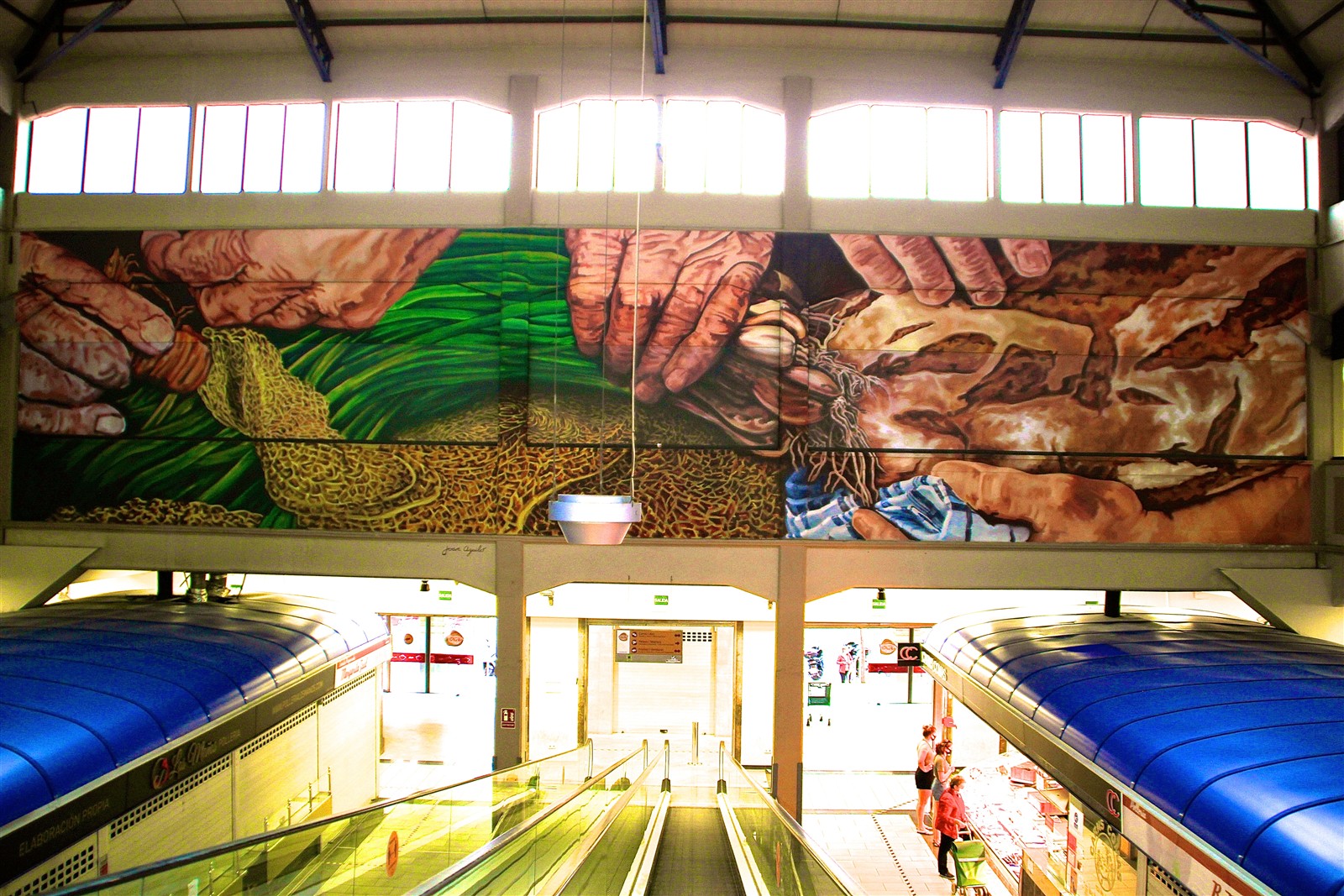
    The mural above the escalators inside Mercat de l'Olivar in Palma de Mallorca
    Inside the Olivar, where the mural above the escalators marks the way down to the lower floor.

    The market sits at Plaça de l’Olivar 4, tucked between Plaça d’Espanya and Carrer de Sant Miquel. From the Old Town it is a flat five to ten minute walk up Carrer de Sant Miquel, and from the Estáció Intermodal it is about four minutes. There is an underground car park directly beneath it, which is genuinely useful in a city where parking is otherwise difficult.

    Hours are the thing to get right, because the market keeps working hours rather than tourist hours. It opens at seven in the morning Monday to Saturday, closes at half past two Monday to Friday, and at three on Saturday. It is closed all day Sunday. The gastronomy area, meaning the bars and counters, runs slightly later than the produce stalls.

    DayMarket hoursWhat it is like
    Monday07:00–14:30Quietest weekday; some fish stalls limited
    Tuesday to Thursday07:00–14:30Full trade, best balance of stock and space
    Friday07:00–14:30Busiest weekday, extended evening trade in parts
    Saturday07:00–15:00Busiest day overall, strong atmosphere, crowded
    SundayClosedCatches out a great many visitors
    Hours per the official Mercat de l’Olivar site, checked September 2026.

    The single most common mistake is arriving on a Sunday, or turning up at three in the afternoon on any day expecting lunch. By two o’clock the produce stalls are packing down and the atmosphere has gone. The useful window is eight until eleven if you want the market working, or midday until two if you have come mainly to eat.

    A Short History of Mercat de l’Olivar

    The market has served Mallorcans and visitors from the same site since 1951, which makes it younger than the city’s trading history but old enough to have shaped how central Palma shops. Before the building existed, the trade happened outdoors in the square, exposed to the weather and to whatever the summer did to fresh fish. Putting a roof over it was as much a public-health decision as a commercial one.

    The name comes from the olive grove that once occupied the ground, which is why you will see it written as both Mercat de l’Olivar in Catalan and Mercado del Olivar in Spanish. Both are correct and locals use both. Signage across the building tends to favour the Catalan.

    A substantial remodelling brought the interior up to modern standards without gutting the trade, which is the part worth appreciating. The lighting, refrigeration and layout are contemporary; the stallholders and the way business is done are not. Several stalls are in their third or fourth generation of the same family, and that continuity is the reason the market still functions as a market rather than as a food hall wearing one as a costume.

    What to Buy at Mercat de l’Olivar

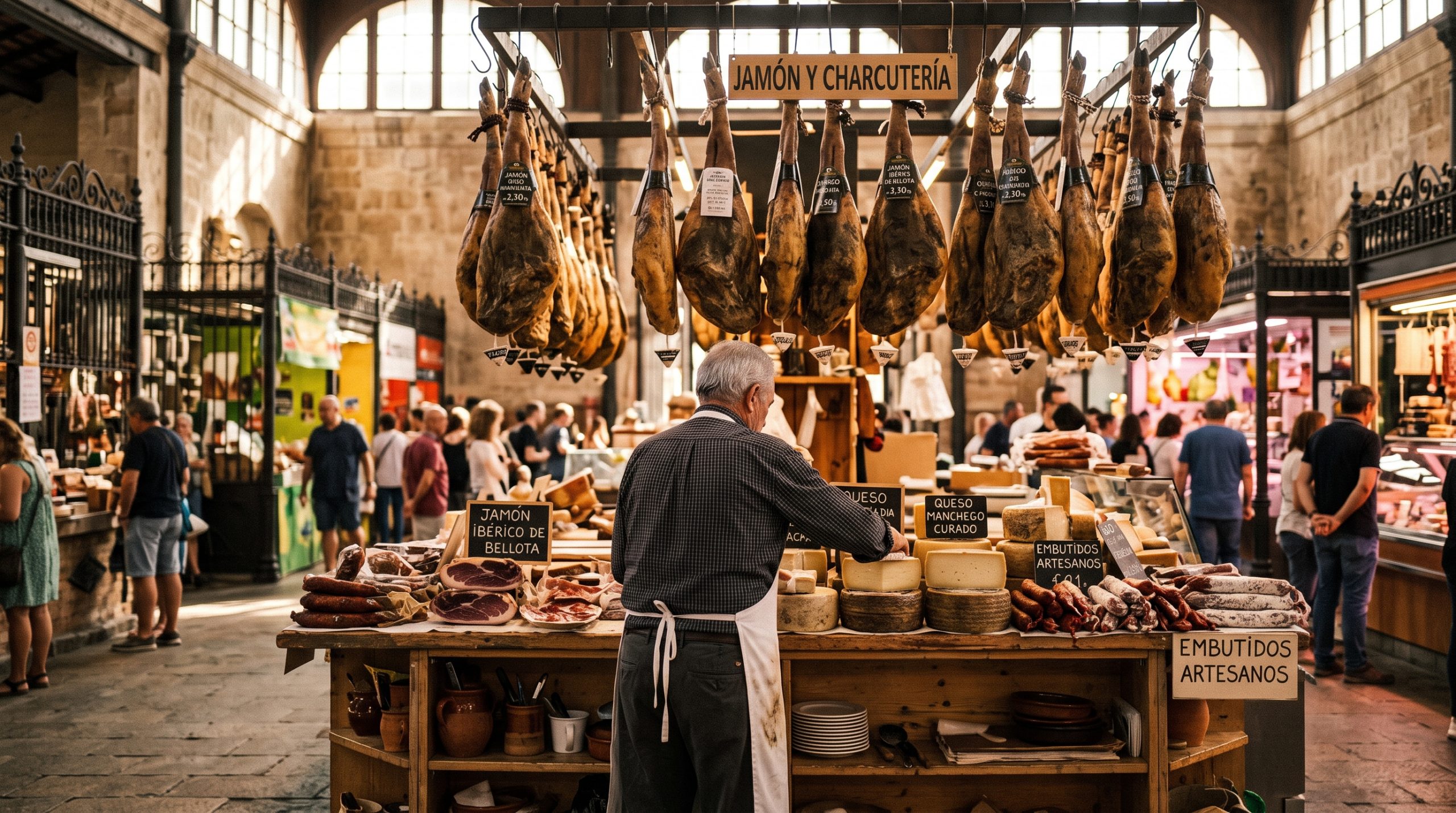
    Cured hams hanging above a charcuterie stall inside a historic Palma food market
    The charcuterie counters, where the sobrassada is worth the detour.

    Around forty-five stalls trade across the building, covering fruit and vegetables, meat and poultry, fish and seafood, cheese, charcuterie, bread and pastries. The layout is straightforward: fish and seafood dominate one section, produce another, and the prepared-food counters sit among them rather than in a separate zone.

    The buys that genuinely travel home are the cured and preserved ones. Sobrassada is the obvious one, and the market is a far better place to buy it than an airport shop, because you can ask which pig it came from and whether it is the protected Sobrassada de Mallorca. Our guide to what sobrassada actually is explains what to look for on the label.

    Beyond that: Mahon cheese from Menorca, island olive oil, almonds, sea salt from the Es Trenc flats, and the flat-cap paprika that gives sobrassada its colour. Traders will vacuum-pack for a flight if you tell them you are travelling, which is worth asking for rather than assuming.

    The produce is worth studying even if you are not cooking. Mallorcan tomatoes are a genuine local speciality, particularly the tomàtiga de ramellet that gets rubbed onto bread for pa amb oli and is sold on the vine in strings. In winter the citrus comes down from the Sóller valley and the oranges are unrecognisable next to supermarket fruit. In late summer the figs and the almonds arrive together.

    The fish counters are the most impressive part of the building and the least useful to most visitors, because almost nobody on a short trip has a kitchen. They are still worth ten minutes. Ask what came from Mallorcan waters rather than the mainland, and you will learn more about the island’s food in that conversation than from any menu.

    What To Buy At Mercat De l’Olivar

    • Sobrassada de Mallorca – ask for the protected designation, and for it to be vacuum-packed.
    • Mahon cheese – the semi-cured is the versatile one; the aged travels better.
    • Island olive oil – Oli de Mallorca carries its own protected designation.
    • Sea salt from Es Trenc – light, cheap and genuinely local.
    • Almonds – Mallorcan almonds are smaller and sweeter than Californian ones.
    • Fresh fish – only if you are self-catering, and only before 11:00.

    Where to Eat Inside Mercat de l’Olivar

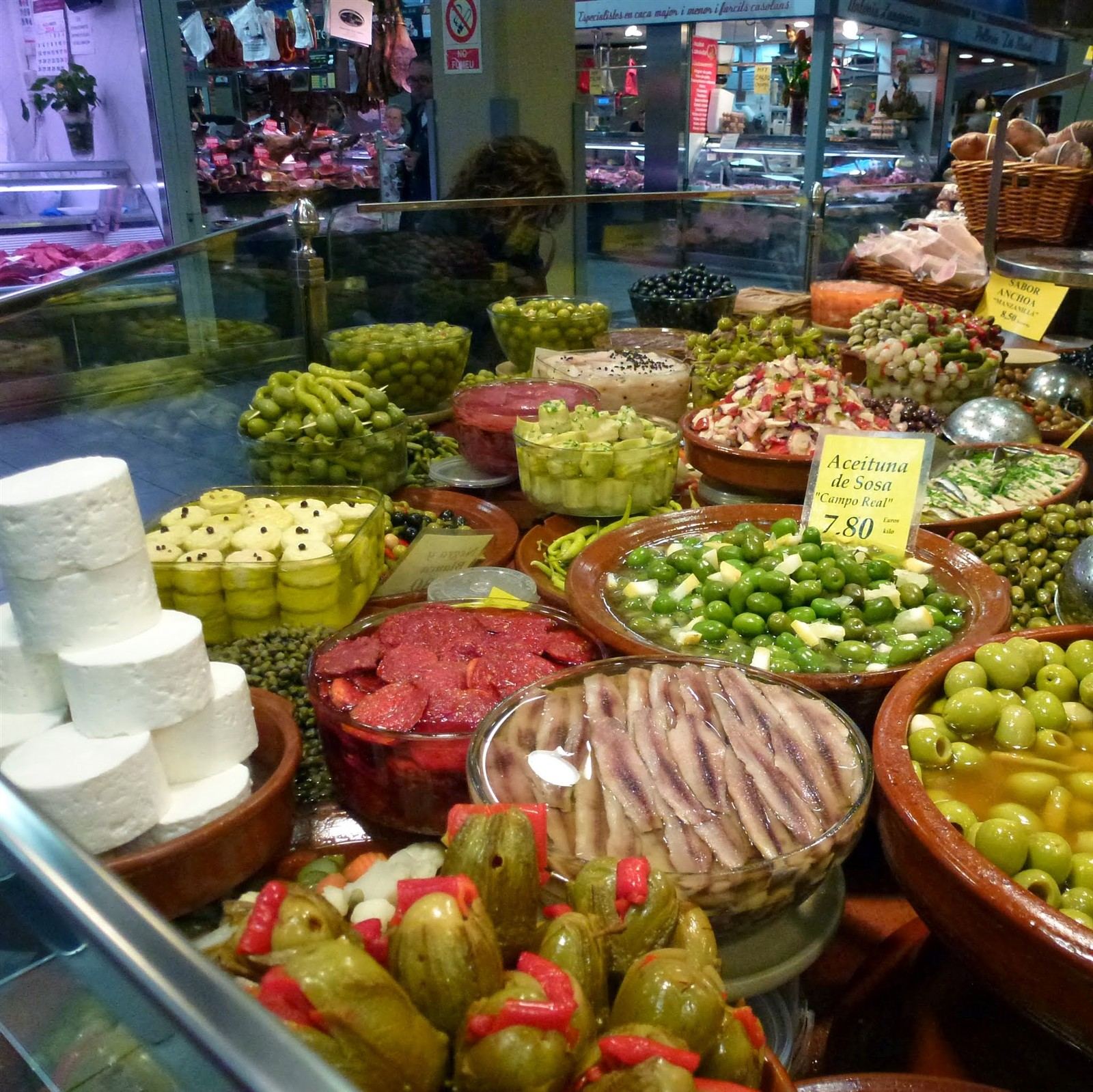
    Olives, pickles, cured meats and sheep cheese on a deli counter inside Mercat de l'Olivar, Palma
    Olives, pickles and cured meats sold by weight, and the reason to bring a bag rather than a plan.

    Eating at the Olivar works on a system that is not obvious from the door. There are proper bars and counters inside, including an oyster bar and a sushi counter, and you can sit at any of them and order from a menu like a normal restaurant. That is the easy version and it is perfectly good.

    The better version is the local one: buy something raw at a stall, carry it to one of the bars, and have them cook or plate it for you for a small charge. Prawns, clams, a piece of fish, a slice of cheese. This is normal here and nobody will find the request strange. It is also considerably cheaper than ordering the same thing off a menu.

    Timing again matters. The counters are busy with market traders and local office workers between one and two, which is exactly when the atmosphere is best and a seat is hardest. Arriving at half past twelve is the compromise. For bar-hopping beyond the market walls, our guide to the best tapas bars in Palma picks up where the market leaves off.

    What to order depends on the counter. At the oyster bar, a half dozen with a glass of cava is the standard and costs less than the equivalent in most northern European cities. At the tapas counters, ask for a variat, the Mallorcan plate of several small things at once, which is the fastest way to taste six island dishes without ordering six of anything.

    Visiting Mercat de l’Olivar Without a Kitchen

    Most visitors are staying in a hotel room with no more than a kettle, which raises a fair question: why go to a food market at all if you cannot cook anything? The honest answer is that the shopping is only half of it, and the half you can do without a kitchen is the more interesting one.

    Eat there rather than buy there. The bars inside are the point for anyone without a stove, and a market lunch of oysters, a variat and a glass of local white is one of the better value meals in central Palma. Then buy only what survives a suitcase: cured, packed, sealed. Sobrassada, cheese, oil, salt, almonds. The market is also a stop on our Palma food tour, which carries on through the Old Town’s bodegas and bakeries.

    The other option is to let someone else deal with the kitchen. A guided market walk followed by a cooking class turns the produce you have just been looking at into lunch, which solves the problem entirely and is the reason that format exists. Either way, do not skip the market because you cannot cook. It is the most concentrated hour of Mallorcan food culture available anywhere in the city.

    How Mercat de l’Olivar Compares with Palma’s Other Markets

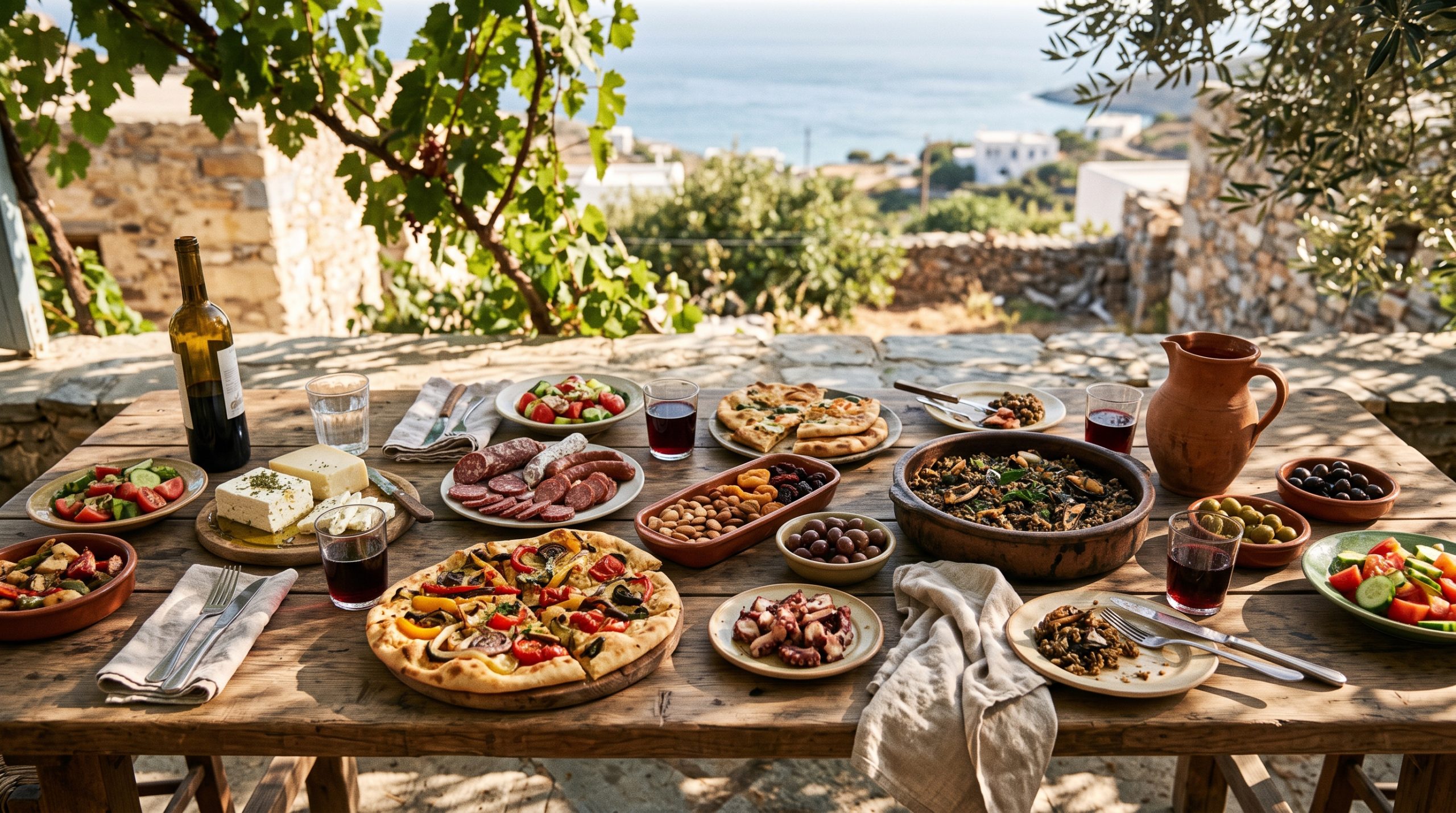
    A table spread of Mallorcan food including cured sausage, sheep cheese, coca flatbread and dark rice
    Most of a Mallorcan table can be assembled inside one market building.

    Palma has three covered markets worth knowing and they are not interchangeable. The Olivar is the largest and the most complete, with the widest range of stalls and the strongest fish section. It is the one to choose if you want to shop rather than simply look.

    Mercat de Santa Catalina, fifteen minutes west, is smaller and more neighbourhood-scaled. It has become the more fashionable of the two, with a stronger bar scene around it and a younger crowd, but it carries fewer stalls and a narrower range. Our Santa Catalina food guide covers that quarter properly.

    Mercat de Pere Garau, east of the centre, is the least visited and the most purely functional. It is where a large part of the city genuinely shops, it has the best value, and it has almost no concessions to visitors at all. Go there third, once the other two have made sense.

    MarketSizeBest forWalk from Old Town
    Mercat de l’OlivarLargest, ~45 stallsFull shop, fish, eating in5–10 min
    Mercat de Santa CatalinaMedium, ~50 stallsNeighbourhood feel, bars around it15–20 min
    Mercat de Pere GarauLarge, localValue, no tourism at all20–25 min
    Walking times measured from Plaça Major, Palma Old Town.

    Walk the Olivar With Someone Who Shops There

    Our market tour starts at Mercat de l’Olivar, works the stalls with a guide who knows the traders, and finishes with a hands-on tapas class using what you bought. Small groups of six.

    Guests seated along the long table in the Tasting Palma tasting room in Palma Old TownA platter of Mallorcan tapas served in small dishes on a dark marble tableTwo tapas served on a wooden board beside a row of Mallorcan wine glassesA guest savouring a tapa during a Tasting Palma experienceGuests and their host toasting with coffee cups at a Palma speciality coffee tastingTwo guests pulling a shot at the espresso machine during a Palma coffee tasting
    See the Market Tour

    How to Visit Mercat de l’Olivar Like a Local

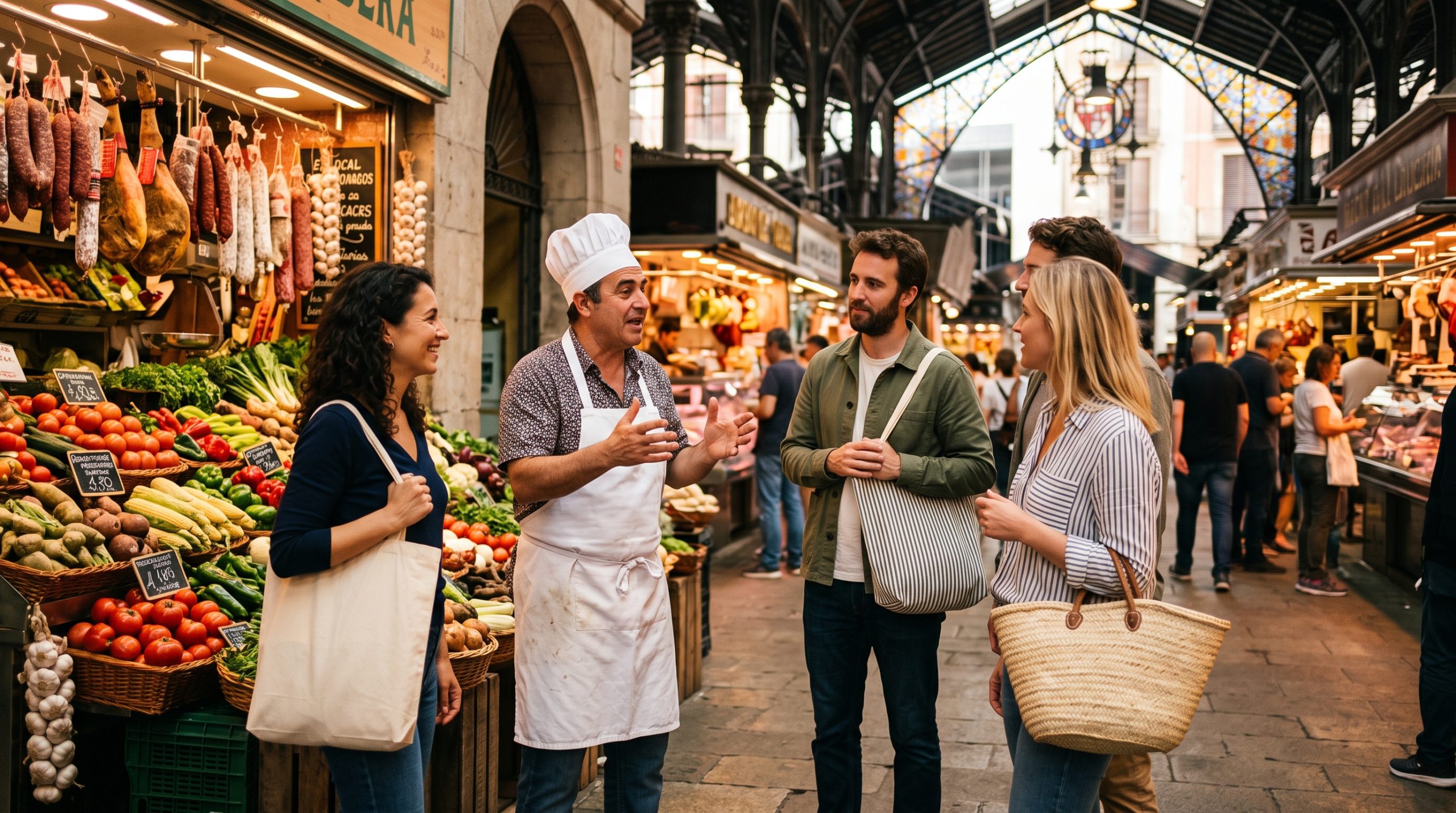
    A guide showing a small group around a stall at the Olivar Market
    The market rewards asking questions, and the traders expect them.

    Take a number. Most stalls run a ticket system, and standing patiently at the front of a counter without one will get you nowhere for a long time. The dispenser is usually at the corner of the stall and nobody will point it out to you.

    Ask what is good today rather than asking for something specific. The traders know what came in that morning and will tell you honestly, including when the answer is that today’s prawns are not worth the money. This is the single behaviour that changes a market visit from shopping into something more interesting.

    Bring cash and a bag. Cards are widely accepted now but small purchases are still smoother in cash, and nobody will give you a carrier bag with any enthusiasm. Buy from more than one stall rather than trying to do everything at one counter, which is how the market is designed to work.

    Say what the food is for. Telling a fishmonger you are cooking it tonight in a rented apartment with one pan gets you a completely different recommendation from asking for the most expensive thing on the ice. The same applies at the charcuterie counter: mention that you are flying home on Thursday and the answer changes, usually to something cured rather than something fresh.

    Do not photograph stalls without asking. It is not that anyone will be rude about it, but the traders are working, and a phone in front of a counter during the busy hour is genuinely in the way. Buy something first and almost everybody will be happy to be photographed afterwards.

    Finally, go twice if you can. The first visit is spent working out the layout and the ticket system; the second is when you actually shop well. The market is small enough that a second visit costs you twenty minutes, and it is the visit where the place starts making sense.

    Best Time to Visit Mercat de l’Olivar

    Between eight and eleven on a Tuesday, Wednesday or Thursday. That is when the stock is complete, the traders have time to talk, and the aisles are busy without being impassable. Fish is at its best in this window and noticeably picked over by one o’clock.

    Saturday is the most atmospheric and the most crowded. If you have come for the spectacle rather than to buy, Saturday morning is the right call, but expect to queue and expect the popular counters to be three deep. Friday runs a close second and has extended trade in parts of the building.

    Avoid Monday if you care about fish, since Sunday landings are limited and some counters run short. And do not plan anything around Sunday itself: the market is closed, and a surprising number of visitors arrive to a locked building having read a guide that did not say so.

    Mercat de l’Olivar: Frequently Asked Questions

    What Are Mercat de l’Olivar Opening Hours?

    Monday to Friday from 07:00 to 14:30, and Saturday from 07:00 to 15:00. The market is closed all day Sunday. The bars and prepared-food counters run slightly later than the produce stalls, but the building empties from about 14:00.

    Where Is Mercat de l’Olivar in Palma?

    At Plaça de l’Olivar 4, between Plaça d’Espanya and Carrer de Sant Miquel. It is a flat five to ten minute walk from Palma Old Town up Carrer de Sant Miquel, and about four minutes from the Estáció Intermodal. There is an underground car park directly beneath the building.

    Is Mercat de l’Olivar Open on Sundays?

    No. Mercat de l’Olivar is closed every Sunday, which is the most common mistake visitors make. If Sunday is your only free morning, plan something else and come to the market on a weekday instead, ideally Tuesday to Thursday.

    Can You Eat at Mercat de l’Olivar?

    Yes. There are tapas bars, an oyster counter and a sushi counter inside, and you can order from them like a restaurant. The local method is better value: buy something raw at a stall and take it to one of the bars, which will cook or plate it for you for a small charge.

    What Is the Best Time to Visit Mercat de l’Olivar?

    Between 08:00 and 11:00 on a Tuesday, Wednesday or Thursday. Stock is complete, the fish counters are at their best, and the traders have time to talk. Saturday is the most atmospheric but also the most crowded, and Monday can be short on fish after limited Sunday landings.

    How Many Stalls Does Mercat de l’Olivar Have?

    Around 45 stalls across the building, covering fruit and vegetables, meat and poultry, fish and seafood, cheese, charcuterie, bread and pastries, plus the bars and prepared-food counters. It has traded on the same site since 1951 and is the largest covered market in Palma.

    What Should You Buy at Mercat de l’Olivar to Take Home?

    Sobrassada de Mallorca, Mahon cheese, island olive oil, Es Trenc sea salt and Mallorcan almonds all travel well. Ask the trader to vacuum-pack anything cured or fresh if you are flying, which they will do without fuss if you say so before they wrap it.

    Is Mercat de l’Olivar or Santa Catalina Market Better?

    The Olivar is larger and more complete, with the widest range of stalls and the stronger fish section, so it is the better choice for actually shopping. Santa Catalina is smaller and more neighbourhood-scaled, with a livelier bar scene around it. They are 15 to 20 minutes apart and worth seeing on separate mornings.

    Shop the Market, Then Cook It

    A guided walk through Mercat de l’Olivar with someone who buys there weekly, followed by a hands-on Mallorcan tapas class. Six guests maximum.
    Book the Market Tour Ask Us a Question

    Photographs of Mercat de l’Olivar by Enric (CC BY-SA 4.0), chixoy (CC BY-SA 3.0) and Nikolay Maksimovich (CC BY 3.0), via Wikimedia Commons.
  • Best Bars in Palma Old Town: Bodegas, Vermouth and Rooftops

    Best Bars in Palma Old Town: Bodegas, Vermouth and Rooftops

    At A Glance

    The best bars in Palma Old Town are not one scene but four: barrel bodegas, vermouth counters, pincho bars and a handful of hotel rooftops on the edge of the quarter.

    • A glass of house wine from the barrel runs roughly €2 to €3.50. A rooftop cocktail runs €14 to €18.
    • Vermut is a Saturday and Sunday ritual here, poured from about 12:30 until lunch.
    • The Old Town has almost no true rooftops inside the walls. They sit on its edges, in hotels.
    • Bars fill from 21:00. Arriving at 19:30 means an empty room and a bored barman.
    • Walk east of the town hall for locals, west towards the Born for visitors and higher prices.

    Ask ten people for the best bars in Palma Old Town and you will get ten lists that share almost nothing, because they are answering four different questions. Someone wants a barrel of Mallorcan wine and a plate of olives for under a fiver. Someone else wants a cocktail with a cathedral view. Both are in the Old Town. They are three hundred metres and about fifteen euros apart.

    This guide splits the Old Town bar scene into the four things it actually is, so you can pick the one that matches your evening rather than following a list that mixes them together. If you are looking specifically for food rather than drinks, our guide to the best tapas bars in Palma de Mallorca covers where to eat rather than where to drink.

    Everything below sits inside the medieval quarter or on its immediate edge, which means you can walk between all of it in under twenty minutes. That compactness is the real argument for drinking in the Old Town rather than heading out to Santa Catalina or the Paseo Marítimo.

    Where the Best Bars in Palma Old Town Actually Are

    Narrow Palma Old Town lane with bar tables and warm lamplight at dusk
    The lanes east of the town hall, where most of the Old Town’s drinking actually happens.

    The Old Town is not evenly distributed. Draw a line down the Passeig del Born and the character changes completely on either side of it. West, towards the Born and Jaume III, you get hotel bars, international cocktail lists and terrace pricing. East, into the lanes around Plaça Santa Eulàlia and up into Sa Gerreria, you get bodegas, vermouth counters and rooms full of people who live here.

    The most useful rule for finding good bars in Palma Old Town is distance from the cathedral. The approach streets between La Seu and the Born carry the highest concentration of visitors and the highest prices, and the quality is inconsistent. Three or four streets inland the same glass of wine costs half as much and the room sounds different.

    Sa Gerreria deserves a specific mention. It was the old potters’ quarter, was rough for decades, and has been steadily rebuilt over the past fifteen years into the part of the Old Town with the highest density of small independent bars. It is still scruffy in places. That is the point.

    Bars in Palma Old Town Compared

    Four types, four different evenings. Prices are for a standard drink in shoulder season and rise in July and August.

    Type of barWhat you orderTypical priceBest timeWhere in the Old Town
    Barrel bodegaHouse red or white from the barrel€2–€3.5020:00–23:00Santa Eulàlia, La Rambla end
    Vermouth counterVermut de grifo with orange and olive€3–€512:30–14:30, weekendsSa Gerreria, Santa Eulàlia
    Pincho barPinchos by the stick, caña of beer€1.80–€3 each19:30–22:00Around Plaça del Mercat
    Cocktail barClassics and signatures€10–€1421:00 onwardsLanes off the Born
    Hotel rooftopSpritz, gin and tonic, cava€14–€1819:00–21:30 for sunsetEdges of the quarter
    Prices observed in Palma Old Town, shoulder season 2026.

    The Best Bars in Palma Old Town by Type

    Ordered from the most traditional to the most polished. If you only have one night, start with the first.

    1. Barrel Bodegas: The Most Traditional Bars in Palma Old Town

    Vermouth being poured at a traditional Palma bodega counter lined with oak wine barrels
    Oak barrels behind the counter are the signature of a genuine Palma bodega.

    A bodega in the Palma sense is a wine shop that grew a bar. The oak barrels behind the counter are not decoration, they are stock, and the house wine is drawn from them into a small tumbler rather than a wine glass. These are the oldest bars in the Old Town and several have been trading in the same room for sixty or seventy years.

    What you get is a glass of Mallorcan red or white for two to three euros, a plate of olives or almonds without asking, and a room where nobody is performing for anybody. The food is incidental and usually excellent: sobrasada on toast, a variat of small plates, tinned anchovies that cost more than the wine. Order at the bar, tell them what you have had when you leave, and pay then. Old Town bodegas are also one of the stops on our small-group tapas tour.

    These bars close earlier than you expect. Many stop serving around eleven and some shut on Sundays entirely. They are also the hardest type to find by searching, because most have no website and several have no sign. Walking the lanes east of Plaça Santa Eulàlia and looking through open doors for barrels is genuinely the method.

    2. Vermouth Bars: The Weekend Ritual in Palma Old Town

    A glass of red vermouth with orange and olive beside a dish of anchovies on a marble bar
    Vermut de grifo, poured from the tap with an orange slice and an olive.

    Vermut is not a drink here so much as a time of day. From roughly half past twelve on a Saturday or Sunday, Palma sits down with a glass of red vermouth on ice, a slice of orange, an olive on a stick, and something salty to go with it. It runs until lunch and then stops. Ordering vermut at nine in the evening will get you served, but you will be the only one.

    Look for the phrase vermut de grifo, meaning on tap. The tapped house vermouth is usually made locally, is softer and less sweet than the bottled Italian style, and costs three to five euros. It arrives with anchovies, crisps or olives without you asking. This is the single most Mallorcan hour of the week and it costs almost nothing to join.

    The vermouth bars cluster in the same lanes as the bodegas, and several bars are both. The distinction is the hour rather than the address: the same counter that pours vermut at one o’clock will be pouring wine at nine. If you want to understand how Palma actually drinks, come on a Sunday at half past twelve rather than a Friday at ten.

    3. Pincho and Counter Bars in Palma Old Town

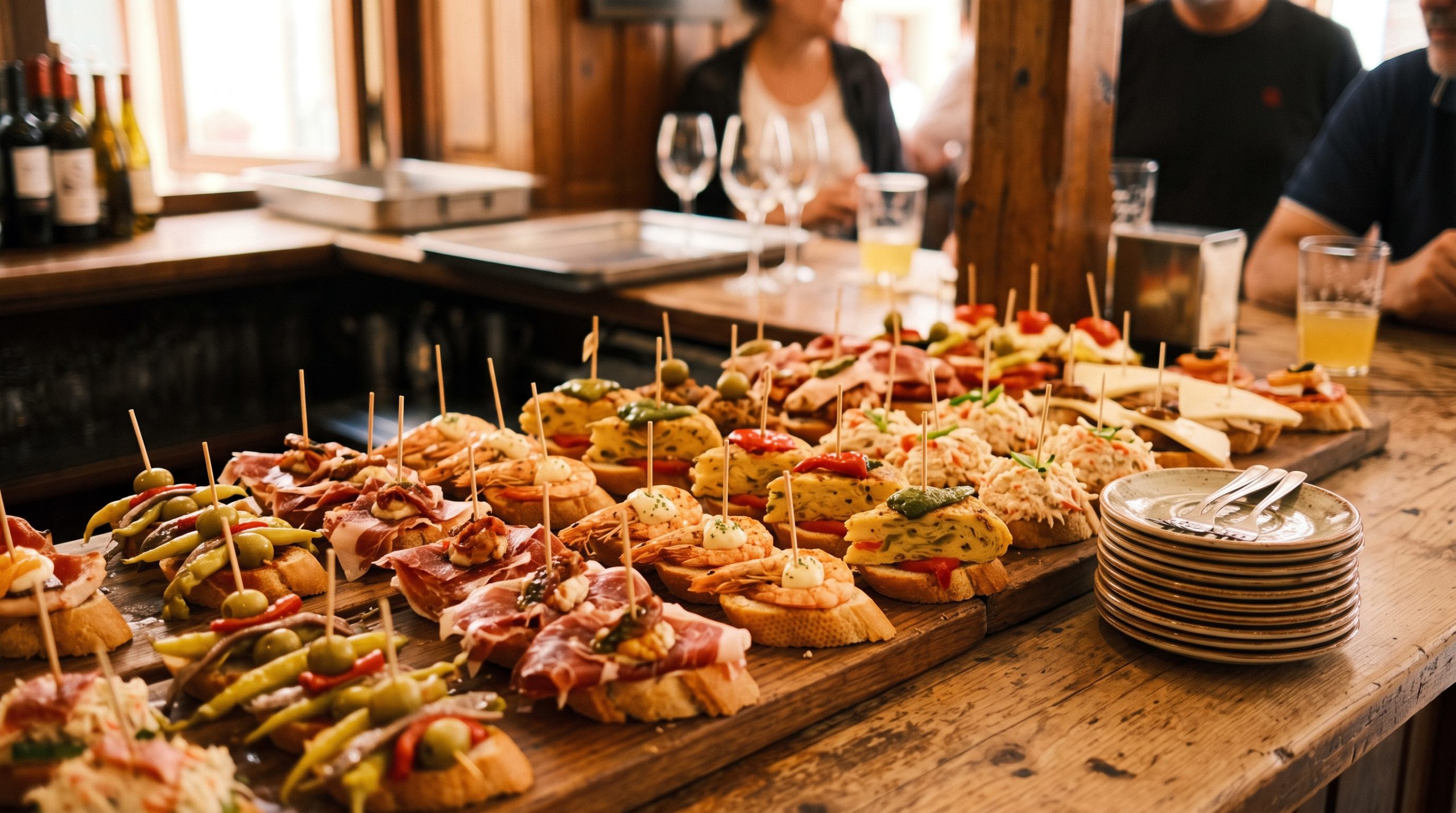
    Rows of pinchos on bread held with cocktail sticks along a Palma bar counter
    Pinchos laid along the counter, priced by the stick.

    Pincho bars work on a simple system that confuses visitors for about ten minutes and then becomes the easiest way to eat and drink in the city. Small pieces of bread with something on top are laid out along the counter, each held together with a cocktail stick. You take what you want, eat standing up, and keep the sticks.

    At the end the barman counts your sticks and charges you, usually between €1.80 and €3 each. Order a caña, the small draught beer, rather than a pint: it stays cold, it is what everybody else is drinking, and it costs about two euros. The whole exercise rarely passes fifteen euros a head.

    This is a Basque import rather than a Mallorcan tradition, so purists will tell you it is not local. They are right and it does not matter. It is the most efficient early-evening option in the Old Town, it works well for a group who cannot agree on a restaurant, and it fills the gap between six and nine when Mallorcan kitchens are still closed.

    4. Cocktail Bars in Palma Old Town

    Palma’s cocktail scene has grown considerably in the past decade and the good rooms are hidden in the lanes off the Born rather than on it. Expect ten to fourteen euros for a well-made classic, proper ice, and bartenders who will build something to a description if you give them one.

    The local angle worth pursuing is gin. Mallorca has a real distilling scene now, and the better Old Town bars stock island gins alongside the international names. Asking for a gin and tonic made with a Mallorcan gin will usually get you a short conversation and something more interesting than a Hendrick’s. Our Mallorca gin guide covers which distilleries are worth knowing by name.

    Timing matters more here than anywhere else in this guide. Cocktail bars in the Old Town are quiet until nine and busy from half past ten. If you want a seat and a conversation with the bartender, arrive early. If you want atmosphere, arrive late.

    5. Rooftop Bars In and Around Palma Old Town

    Hands sharing small plates and white wine at a sunny terrace table in Palma
    Terrace drinking in Palma, where the view is usually worth the mark-up.

    Here is the thing most rooftop lists will not tell you: the Old Town has very few genuine rooftop bars inside its walls. The medieval quarter is protected, the buildings are low and tightly packed, and you cannot simply put a terrace on top of a listed sandstone townhouse. Almost every rooftop in Palma sits in a hotel, and most of those hotels are on the edges of the quarter rather than in the middle of it.

    That is not an argument against going. A rooftop with the cathedral lit up in front of you is worth doing once, and the good ones are genuinely good. It is an argument for treating it as a separate errand rather than expecting to stumble across one. Budget €14 to €18 a drink, book if you want sunset in July or August, and check whether the terrace is guests-only before you walk over.

    The practical play is to use a rooftop for the hour before dinner and then come down into the lanes. Sunset drinks at seven, a table in a bodega at nine. That sequence gives you the view and the city, which is more than either gives you alone.

    When to Drink at Bars in Palma Old Town

    Timing is the single biggest thing visitors get wrong, and it is the reason people conclude that the Old Town is dead when in fact they simply arrived two hours early.

    Mallorcan bars run late. A bodega at half past seven will have three people in it and none of them will be under fifty. The same room at half past nine will be three deep at the counter. Cocktail bars run later still and do not really begin until ten. If you are used to a northern European evening, everything here happens roughly two hours after you expect it.

    The exceptions are worth knowing. Vermouth is a midday ritual and only at weekends. Pincho bars are the one category that works early, which makes them useful if you are eating with children or have an early start. And Sunday evening is quiet across the whole quarter, with a good number of the traditional bars closed entirely.

    Which Bar In Palma Old Town Suits You

    • First night, want the real thing: a barrel bodega east of Plaça Santa Eulàlia, from 21:00.
    • Sunday lunchtime: vermut de grifo, 12:30, anywhere in Sa Gerreria.
    • Eating early or with children: a pincho counter from 19:30.
    • Celebrating something: a hotel rooftop for sunset, then down into the lanes.
    • Want to drink local spirits: a cocktail bar off the Born, and ask for Mallorcan gin.
    • On a budget: bodegas and pinchos. Two people can drink and eat well for €30.

    How Bars in Palma Old Town Compare with Santa Catalina

    The two drinking districts are fifteen to twenty minutes apart on foot and they are not competing for the same evening. The Old Town is older, denser and more traditional, and its best rooms are the ones that have not changed. Santa Catalina is newer to the scene, more design-led, and its bars skew towards cocktails, natural wine and a younger crowd.

    If you want barrels, vermouth and a room where the average age is sixty, stay in the Old Town. If you want somewhere that fills at eleven and has a queue, walk west. Our Santa Catalina food guide covers that quarter in detail, including which streets carry the bars.

    Most visitors with three or four nights should do both, on separate evenings, rather than trying to combine them. The walk between them at midnight is straightforward and well lit, but doing both in one night means rushing the part you would have preferred.

    Drink Mallorcan, With Someone Who Knows the Bottles

    Our small-group tastings run in Palma Old Town: Mallorcan wines with tapas pairings, island gins with a host who can explain the botanicals, and speciality coffee with a 75-year-old roastery. Groups of six or fewer.

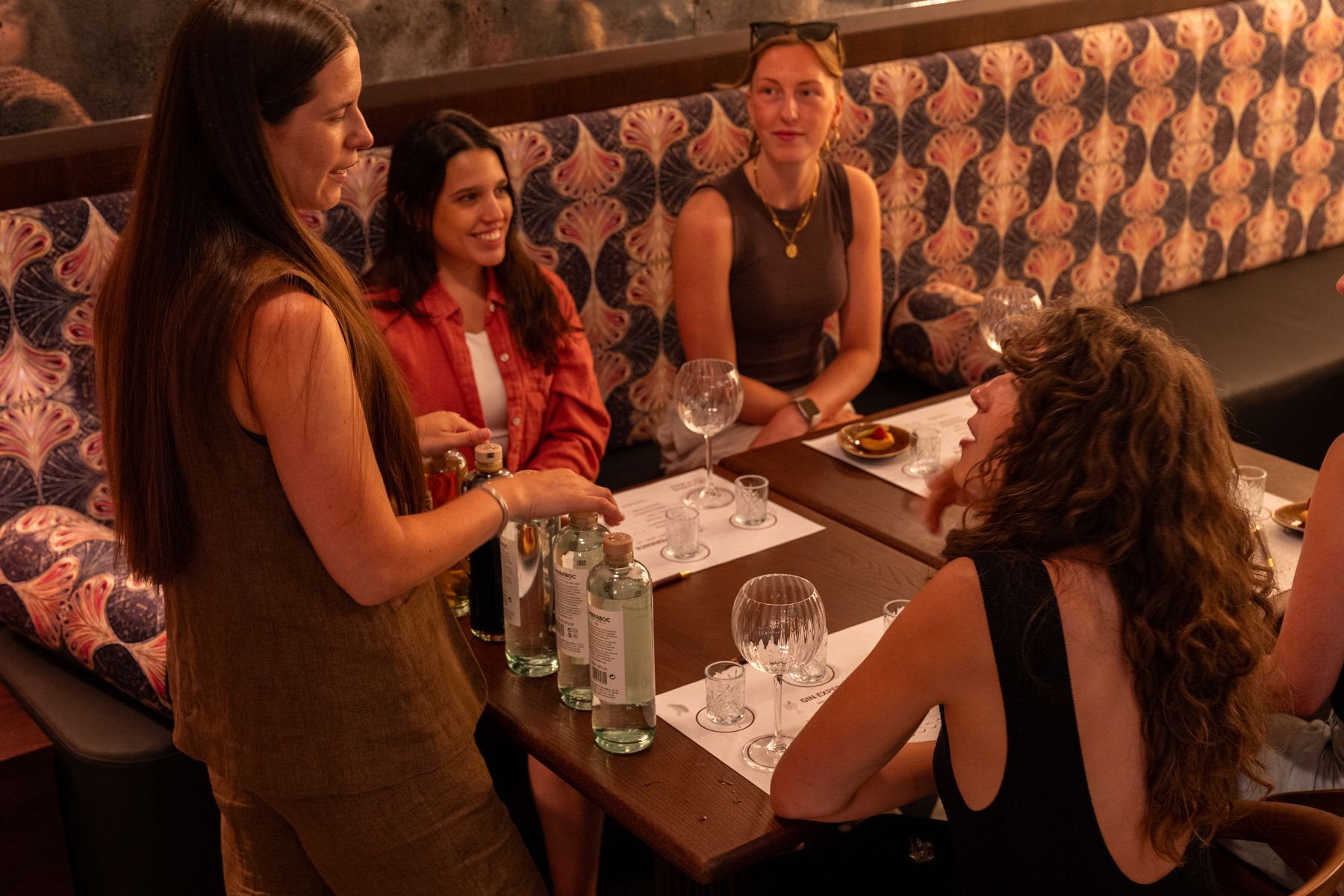
    Guests seated along the long table in the Tasting Palma tasting room in Palma Old TownGuests clinking glasses of Mallorcan red wine at a Tasting Palma tastingGuests raising gin glasses in a toast during a Mallorcan gin tasting in PalmaTwo guests laughing beside a lineup of Mallorcan gin bottles and tasting glassesA Mallorcan gin and tonic being poured over ice in a cut glass tumblerTwo tapas served on a wooden board beside a row of Mallorcan wine glasses
    See Our Tastings

    Practical Notes for Drinking in Palma Old Town

    Pay at the end, not per round. In a bodega or a traditional bar you run a tab by memory. The barman will remember what you had, and being asked to pay for each drink as it arrives is a sign you are in a tourist room.

    Tipping is light. Rounding up or leaving small change on the counter is normal and sufficient. Nobody expects a percentage, and leaving twenty per cent will mark you out more than it will please anyone.

    Standing is cheaper than sitting in some bars, and sitting on a terrace can carry a surcharge again. It is rarely a large difference in the Old Town, but it explains why the counter is full and the tables are empty. If you want to know what a place is really like, stand at the bar. For a full picture of eating as well as drinking, our Palma food guide sets out what to order across the city.

    Most traditional bars do not take reservations, and several of the older bodegas still do not take cards. Carry twenty or thirty euros in cash for an evening in the eastern lanes. The rooftops and cocktail bars are the opposite: card everywhere, and worth booking at weekends between June and September.

    Groups above about six become difficult in the Old Town. The rooms are small, the bars are historic and cannot be reconfigured, and a party of eight arriving unannounced at half past nine will usually be split across two ends of a counter. If you are a larger group, either book somewhere that takes reservations or accept that you will be standing.

    One last thing worth saying plainly, because no list will tell you: the best bar in Palma Old Town on any given night is usually the one that is full of people speaking Catalan or Spanish. That single test will serve you better than any ranking, including this one.

    Bars in Palma Old Town: Frequently Asked Questions

    What Are the Best Bars in Palma Old Town?

    It depends which of the four scenes you want. For tradition, the barrel bodegas east of Plaça Santa Eulàlia, where house wine is €2 to €3.50 a glass. For a weekend ritual, a vermouth counter in Sa Gerreria from 12:30. For cocktails, the lanes off the Passeig del Born. For a view, a hotel rooftop on the edge of the quarter at €14 to €18 a drink.

    Are There Rooftop Bars in Palma Old Town?

    Very few inside the walls. The medieval quarter is protected and the buildings are low and tightly packed, so almost every rooftop bar in Palma sits in a hotel on the edge of the Old Town rather than in the middle of it. Treat a rooftop as a separate trip for sunset rather than something you will walk past, and check whether the terrace is open to non-guests.

    What Time Do Bars in Palma Old Town Get Busy?

    Bodegas and tapas bars fill from about 21:00 and peak between 22:00 and midnight. Cocktail bars start later, around 22:30. Arriving at 19:30 will usually mean an almost empty room, which is the most common mistake visitors make. The exceptions are pincho bars, which work from 19:30, and vermouth, which is a midday ritual at weekends.

    How Much Do Drinks Cost in Palma Old Town Bars?

    House wine from the barrel is roughly €2 to €3.50 a glass and a caña of draught beer about €2. Vermut de grifo runs €3 to €5 and usually arrives with olives or anchovies included. Cocktails are €10 to €14 in the Old Town and €14 to €18 on a hotel rooftop.

    What Is Vermut and Where Do You Drink It in Palma Old Town?

    Vermut is red vermouth served over ice with a slice of orange and an olive, and in Palma it is a weekend midday ritual rather than an evening drink. Ask for vermut de grifo, meaning on tap, which is usually made locally and softer than bottled Italian styles. The counters around Sa Gerreria and Plaça Santa Eulàlia pour it from about 12:30 on Saturdays and Sundays.

    Are Bars in Palma Old Town or Santa Catalina Better?

    They suit different evenings. The Old Town is older and more traditional, with barrel bodegas, vermouth counters and an older crowd. Santa Catalina is more design-led and skews to cocktails, natural wine and a younger scene that fills later. They are a 15 to 20 minute walk apart, so with three or four nights it is worth doing both on separate evenings.

    Do You Tip at Bars in Palma Old Town?

    Only lightly. Rounding up the bill or leaving small change on the counter is normal and entirely sufficient. Percentage tipping is not expected in Mallorcan bars, and leaving 20 per cent will mark you out as a visitor more than it will please the staff.

    Which Bars in Palma Old Town Serve Mallorcan Wine and Gin?

    The barrel bodegas pour Mallorcan house wine by default, usually from Binissalem or Pla i Llevant. For island gin, ask at the better cocktail bars off the Born, which increasingly stock Mallorcan distillers alongside international names. A guided tasting is the fastest way to try several side by side and learn which producers to look for on a bar list.

    Taste Mallorca Properly, in the Old Town

    Small-group wine, gin and coffee tastings in the heart of Palma, hosted by people who know the producers. Six guests maximum, from €34 per person.

    Book a Wine Tasting Ask Us a Question
  • Tumbet: Mallorca’s Layered Vegetable Dish, and How to Make It

    Tumbet: Mallorca’s Layered Vegetable Dish, and How to Make It

    At A Glance

    Tumbet is a Mallorcan dish of potato, aubergine and red pepper, each fried separately in olive oil, then layered under tomato sauce.

    • The layer order is fixed: potato at the bottom, then aubergine, then pepper, with the sauce on top.
    • Frying each vegetable separately is the defining technique. Cook them together and you have made a pisto, not a tumbet.
    • Mallorcans serve it at room temperature, not hot. It is a summer dish.
    • Whether courgette belongs in it is a genuine argument on the island, not a matter of preference.
    • Everything in it is in season on Mallorca from July to October, peaking July to September.

    Tumbet is the dish that proves Mallorcan cooking is not simply Spanish cooking with a sea view. It looks like ratatouille, it is often described as ratatouille, and it is not ratatouille. The difference is entirely in the method, and the method is the reason a plate of three cheap vegetables ends up tasting like three distinct things rather than one. It is on the menu of nearly every traditional kitchen on the island, and it is one of the dishes people cook on our Olivar Market Tour and Tapas Class.

    Below is what it is, where it came from, how to make it properly, and the two arguments Mallorcans actually have about it: courgette, and whether you are allowed to skip the frying. There is also a straight answer on how it relates to pisto and ratatouille, which most recipes dodge. For the rest of the island repertoire, see our Palma food guide.

    Learn to cook tumbet and the rest of the Mallorcan repertoire with a chef, after shopping the market for it.

    See the cooking class

    What Is Tumbet?

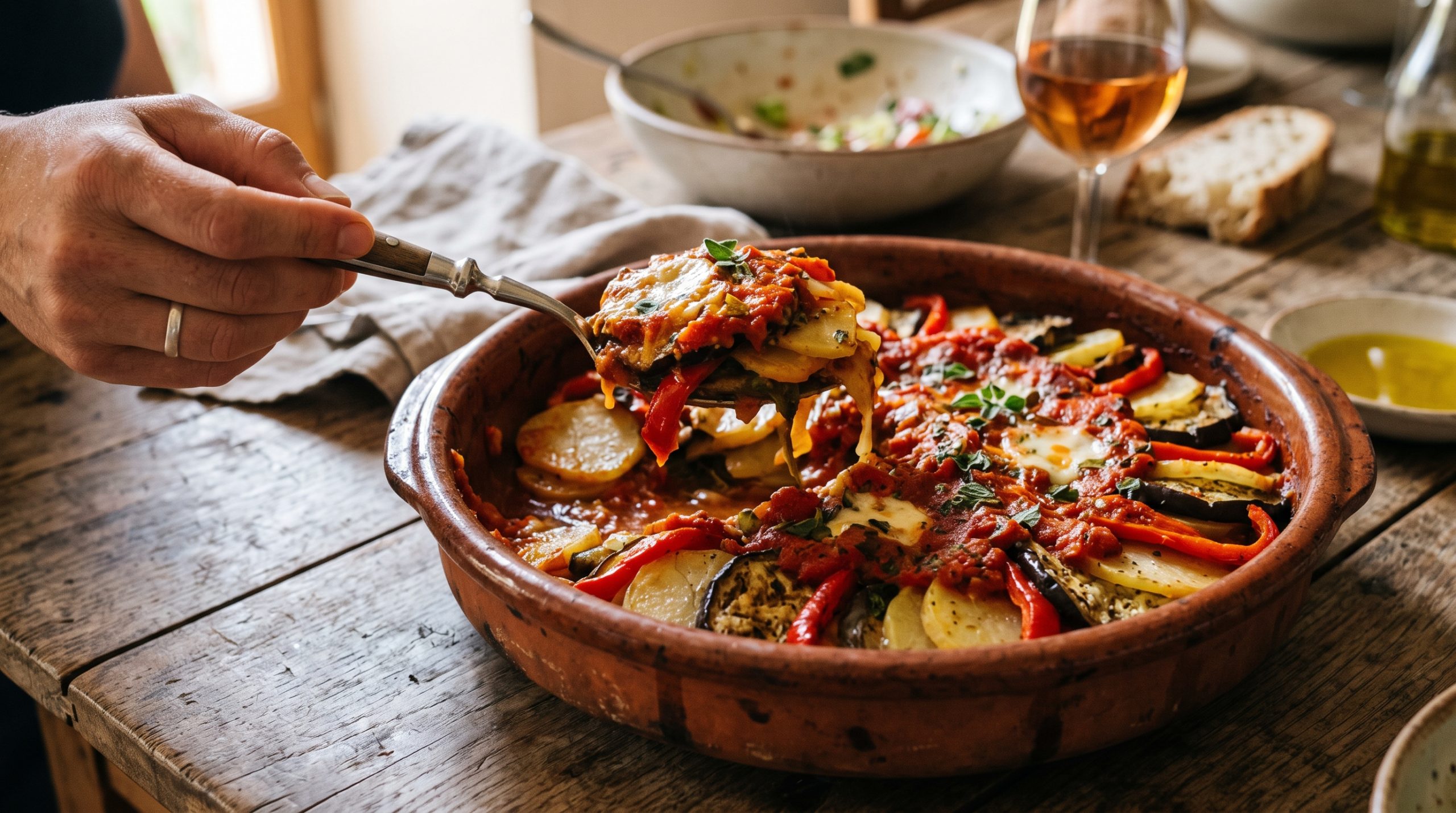
    Tumbet, the Mallorcan layered vegetable dish, in an earthenware dish
    Layered, not stirred. The potato goes in first and the sauce goes on last.

    Tumbet, or tombet in Catalan, is a layered vegetable dish from Mallorca. Potatoes, aubergines and red peppers are sliced, fried individually in olive oil, drained, then layered into an earthenware dish called a greixonera and covered with a simple tomato sauce. It is usually given a short bake and then left to settle.

    The order of the layers is not decorative. Potato goes at the bottom, where it absorbs the sauce and the oil that renders down through the dish. Aubergine sits in the middle. Pepper goes above that, and the tomato sauce covers the lot. Vegetables are sliced with their skins on.

    Its history is older and stranger than most recipe sites admit. It evolved from medieval Mallorcan greixoneres, aubergine dishes that predate the arrival of New World crops entirely, which means the dish existed in some form before it had either tomatoes or peppers to put in it. More striking still, the standard Catalan dictionary’s first definition of tombet describes a fried dish of meat, potatoes, peppers and tomato, with no aubergine at all. The vegetarian version everyone now knows is very likely the later one.

    You will see confident claims that tumbet dates to the sixteenth century, or that it was first recorded in 1886. Neither is supported by a document we could verify, so treat them as received tradition rather than fact. The same goes for the word itself: the standard Catalan dictionary records tombet without any etymology, and the current dictionary of the Institute of Catalan Studies does not list it at all. The usual explanations, from tombar meaning to turn over, or from the vegetables being laid in tombs, are plausible and unproven. At least one Spanish gastronomy publication says so outright. It is a reminder that much of what gets stated confidently about Mallorcan food history is tradition rather than record.

    Tumbet Ingredients

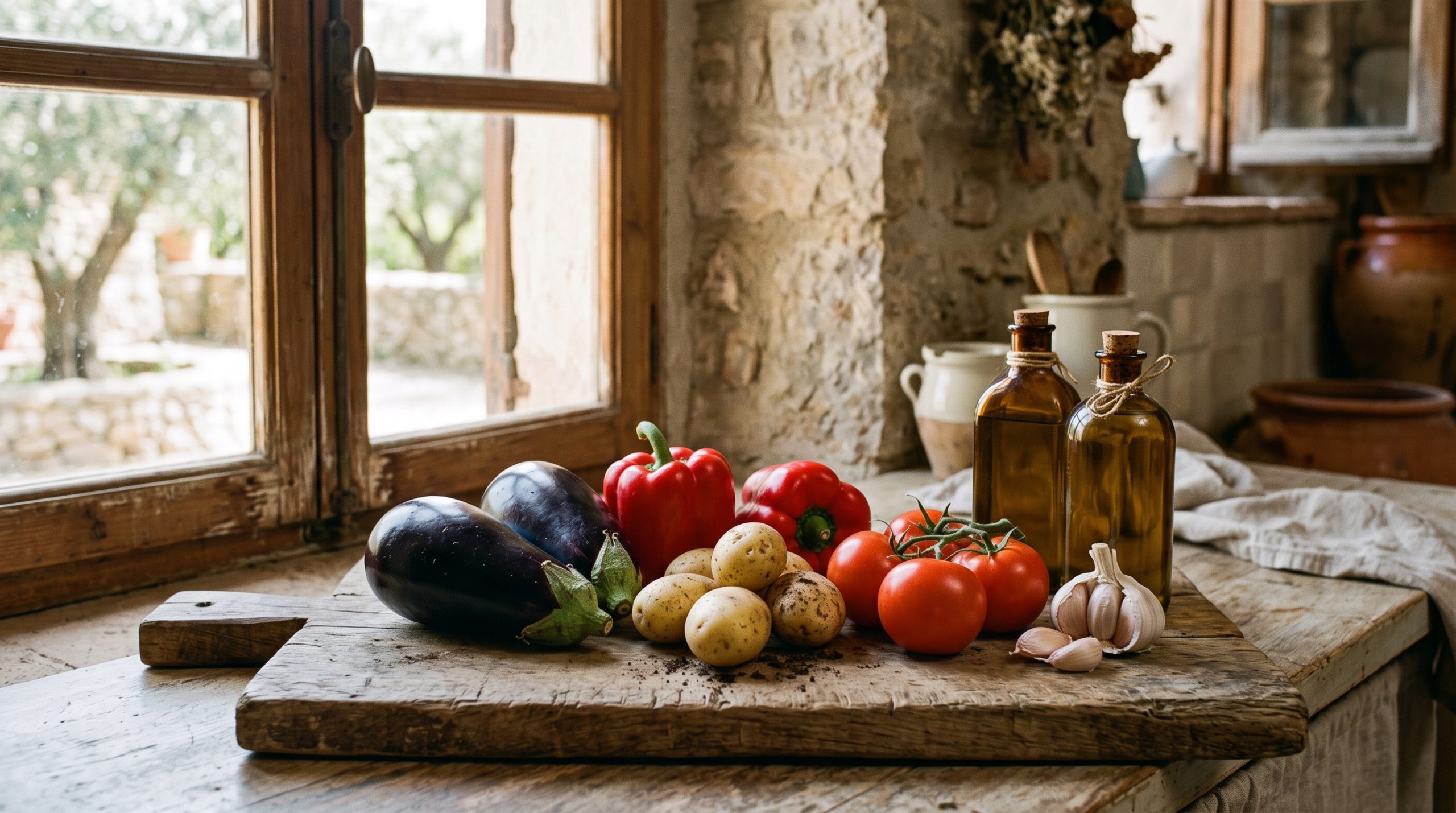
    Aubergines, red peppers, potatoes, tomatoes and olive oil, the ingredients for tumbet
    Four vegetables, garlic, oil and salt. The argument is over whether a fifth belongs.

    Quantities below serve four, following the version published by the Spanish gastronomy title Gastronosfera, which matches the stricter four-vegetable definition. There is no canonical recipe issued by any Mallorcan institution, so this is a well-sourced starting point rather than a decree.

    IngredientFor 4Notes
    Potatoes4 largeWaxy. Monalisa or Kennebec are the varieties named
    Aubergines2 mediumSliced with the skin on
    Red peppers2 largeSome cooks roast rather than fry these
    Ripe tomatoes1 kgFor the sauce, not for layering raw
    Garlic4 clovesInto the sauce
    Extra virgin olive oilGenerousEnough for shallow frying, and it is reused between vegetables
    Salt, sugar, bay leafTo tasteA pinch of sugar balances the tomato

    A word on quantities, because published recipes vary sharply. For the same four servings we found versions calling for eight potatoes, four, and two. That spread tells you something useful: tumbet is a household dish rather than a codified one, and the ratio is a matter of how potato-heavy your family likes it. Start with the middle figure. Buy the vegetables from a market rather than a supermarket if you can, which is the whole argument of our guide to eating in Palma.

    Does Courgette Belong in Tumbet?

    This is the argument, and most English-language recipes do not tell you it exists. They simply include courgette and move on.

    The position against: Catalan reference sources and Mallorcan recipe sites give the dish as potato, aubergine and pepper only, and the Majorca Daily Bulletin has reported plainly that purists consider courgette to make it less authentic. The position for: plenty of Mallorcan households and several island publications include it as standard, and at least one Mallorcan source argues that aubergine and courgette were both later additions to what was originally a simpler dish.

    Where The Arguments Actually Are

    • Courgette. Purists exclude it. Many households include it. Sources even disagree on whether it sits above or below the aubergine.
    • Roasting the peppers instead of frying them is common and uncontroversial.
    • The bake. Some cooks skip the oven, rest the dish a couple of hours and reheat it gently instead.
    • Serving temperature. Room temperature is the Mallorcan norm, though it is served warm in restaurants.
    • What is not argued about: frying the vegetables separately. That part is the dish.

    Our own position, for what it is worth: cook it without courgette the first time so you can taste what the three-vegetable version does, then add it if you want a lighter, wetter dish. What you should not do is add courgette and then describe the result as the traditional recipe, because a good number of Mallorcans will disagree with you.

    Tumbet recipe card

    Serves 4 · Bake around 180 °C, 15–20 min · Serve at room temperature · Cuisine Mallorcan

    Ingredients

    • 4 large waxy potatoes
    • 2 medium aubergines, skin on
    • 2 large red peppers
    • 1 kg ripe tomatoes, for the sauce
    • 4 cloves garlic
    • Generous extra virgin olive oil, for shallow frying
    • To taste salt, a pinch of sugar and a bay leaf

    Method

    1. Salt and drain the aubergine. Slice the aubergines about a centimetre thick, skin on, salt them and leave them to release water. Pat them dry before frying.
    2. Make the tomato sauce. Grate or blend the tomatoes and cook them down slowly with the garlic, a bay leaf, salt and a pinch of sugar until thick enough to sit on a spoon.
    3. Fry each vegetable separately. Shallow fry the potato slices in olive oil until soft and just gold, then the aubergine, then the peppers. Drain each batch and salt it as it comes out of the pan.
    4. Layer and bake. Layer potato, then aubergine, then peppers in an earthenware dish, pour the sauce over the top and bake at around 180 °C for 15 to 20 minutes.
    5. Let it settle. Leave it to rest so the layers take on the sauce, and serve at room temperature, as Mallorcans do.

    How to Make Tumbet

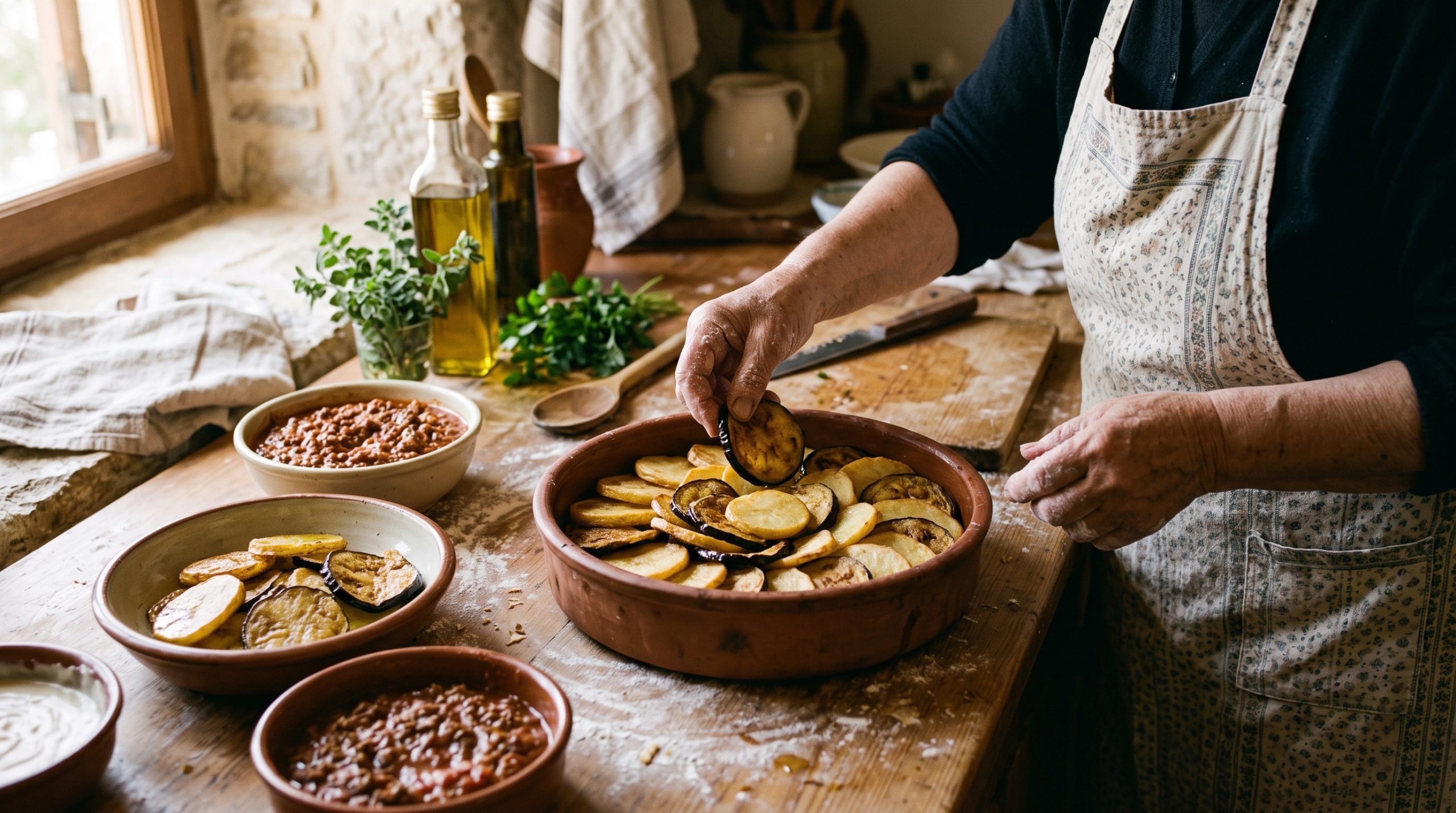
    Slices of aubergine and potato frying in olive oil in a heavy pan
    Each vegetable goes in on its own, and comes out to drain before the next one starts.

    1. Salt and drain the aubergine

    Slice the aubergines about a centimetre thick, skin on, salt them and leave them to sit while you prepare everything else. They will release water. Pat them dry before they go anywhere near hot oil, because wet aubergine in oil spits and steams rather than frying.

    This step is also where a lot of home cooks lose the dish. Aubergine that has not drained will carry water into the layers and make the finished tumbet soupy underneath the sauce.

    2. Make the tomato sauce

    Grate or blend the tomatoes, then cook them down slowly with the garlic, a bay leaf, salt and a pinch of sugar until the sauce is thick enough to sit on a spoon. It should be a plain sauce. No herbs beyond the bay, no onion, nothing clever.

    Make it first and let it sit. A thin, watery sauce will run through the layers and undo the structure you are about to build, which is the single most common failure in a homemade tumbet.

    3. Fry each vegetable separately

    Shallow fry the potato slices in olive oil until they are soft and just gold, and lift them out to drain on paper. Then the aubergine, in the same oil. Then the peppers, unless you are roasting them. Salt each batch as it comes out of the pan, not in it.

    The reason given on the island for keeping them separate is straightforward: it stops the flavours mixing in the oil, and it lets each vegetable be taken off the heat at its own right moment. Potato and aubergine do not want the same amount of time, and cooking them together means one of them is wrong. This is the step people skip, and skipping it is what turns tumbet into something else. It is also the step that is far easier to learn by watching than by reading, which is why it is on the syllabus of our food tour and cooking experiences.

    4. Layer and bake

    Hands layering fried potato and aubergine into an earthenware dish
    Overlapping rounds, potato first. An earthenware greixonera holds the heat evenly.

    Lay the potato across the base of an earthenware dish in overlapping rounds, then the aubergine, then the peppers, seasoning lightly between layers. Pour the tomato sauce over the top so it covers the surface rather than being stirred through. Bake at around 180 °C for fifteen to twenty minutes.

    Then, and this matters more than the baking, leave it alone. Tumbet improves as it settles and the layers take on the sauce. Many Mallorcan cooks make it several hours ahead, or the day before, and simply warm it through gently.

    Inside A Tasting Palma Experience

    Shop the market, then cook it with a chef

    Four hours, eight guests. We buy what is in season at the Olivar, take it back to our Old Town kitchen, and you cook the Mallorcan classics with recipes to take home.

    Guests preparing Mallorcan tapas with a chef in a cooking class A guide showing a small group around a stall at the Olivar Market The Tasting Palma tasting room set with wine glasses and small plates A flight of five Mallorcan wines paired with small tapas plates A small group raising glasses in a toast around a long shared table A speciality coffee cupping set up with grinder, scales and tasting cups
    Book the Market Tour & Tapas Class

    From €149 · 4 hours · Max 8 guests · Gift vouchers available

    Can You Make Tumbet Without Frying?

    You can, and it is worth being clear about what you are trading away. The traditional method is fry, then layer, then give it a short bake. So the oven is not the modern shortcut some articles imply. It is already part of the classic dish.

    The genuinely modern version is the one that replaces the frying with roasting: the vegetables go into the oven in oil rather than into a pan. It is lighter, it uses far less oil, and it is a reasonable weeknight adaptation. What it is not is the same dish, because the frying is what gives the potato and aubergine their texture and what carries the flavour into the oil.

    Interestingly, no Mallorcan authority we could find rules the oven-roasted version out. The only purist objection anyone actually records is about courgette. Roasting your peppers instead of frying them is entirely normal, and one Mallorcan source notes that some households skip the bake altogether and just let it rest. As the same source puts it, each house is a world.

    Tumbet vs Ratatouille and Pisto

    Recipes usually wave at this and move on, often saying it is unclear which came first. Here is a more useful answer.

    Tumbet, ratatouille, pisto, Catalan samfaina and Sicilian caponata are parallel Mediterranean siblings rather than one being descended from another. They arose in different places from the same summer glut of the same New World vegetables. Asking which came first is close to asking which region invented the tomato salad.

    TumbetPistoRatatouille
    WhereMallorcaMainland SpainProvence
    MethodFried separately, then layeredCooked together in one panCooked together, or separately in the refined version
    StructureDistinct layers you can seeStirred, homogeneousStirred, or arranged
    PotatoYes, and it is the baseNoNo
    ServedRoom temperatureHot or warmHot or warm

    The separator is technique, and the potato. Cook the same vegetables together in one pan and you have made a pisto; layer them after frying them apart and you have made a tumbet. Within the Balearics there are close cousins too, including Ibiza’s frita and Menorca’s fritel·la.

    How to Serve Tumbet

    A portion of tumbet served with a fried egg on top and bread alongside
    A fried egg on top turns a side dish into lunch, and is entirely traditional.

    The detail almost every English recipe misses: Mallorcans serve tumbet at room temperature. It is a summer dish, made in heat, and it is not meant to arrive steaming. Restaurants will often serve it warm, but in a Mallorcan home it will have been sitting on the side for a couple of hours by the time you eat it, and it is better for it.

    It works as a starter, as a side for meat or fish, or as a main course in high summer. A fried egg on top is well established and turns it into a full meal. With fish, salt cod is the classic pairing, and grouper and llampuga both appear. With meat, pork is what the Mallorcan sources actually name, usually loin or chops.

    Serve it with plain country bread, and if you want to drink something local with it, a chilled Prensal Blanc handles the oil and the tomato better than a red would. That is the grape we pour on our Mallorcan Wine Tasting, and it is a genuinely good match for most of the island’s vegetable cooking.

    When to Eat Tumbet in Mallorca

    A Mediterranean vegetable garden in summer with tomato, aubergine and pepper plants
    Everything in tumbet is in season together for a short window each summer.

    Tumbet is genuinely seasonal, which is easy to forget when every ingredient is available year round in a supermarket. On Mallorca, aubergines run from July to November, peppers July to October, tomatoes July to November, and potatoes March to October. The overlap, when all of it is at its best at once, is July to October and really July to September.

    That is why island sources describe it as a summer dish prepared when the ingredients are at their peak, and why a tumbet eaten in Palma in August tastes noticeably better than one made in February anywhere. If you are visiting outside that window it will still be on menus, and it will still be good, but the tomatoes will be doing less of the work.

    You will find it in the old cellers, in market bars, and on the menu at most traditional kitchens. The market counters in Santa Catalina serve it as a matter of course. The Old Town tapas bars serve it as a tapa, and it is one of the few dishes on a Mallorcan menu that a vegetarian can order without negotiation, since unlike almost everything else on the island it involves no pork whatsoever, and certainly no sobrasada.

    Frequently Asked Questions

    What Is Tumbet?

    A Mallorcan dish of potato, aubergine and red pepper, each fried separately in olive oil and then layered in an earthenware dish under a plain tomato sauce. It is usually given a short bake and served at room temperature. Potato goes at the bottom, then aubergine, then pepper, then the sauce.

    How Do You Pronounce Tumbet?

    Roughly “toom-BET”, with the stress on the second syllable and a short u as in book. In Catalan it is written tombet and sounds much the same. Nobody on Mallorca will mind either way.

    Why Are the Vegetables Fried Separately?

    So the flavours do not mix in the oil, and so each vegetable can be taken off the heat at its own right moment. Potato and aubergine do not need the same time in the pan. Frying them together produces something closer to a pisto, which is a different dish.

    Is Tumbet the Same as Ratatouille?

    No. They are parallel Mediterranean dishes rather than one deriving from the other. Tumbet contains potato and is built in visible layers from vegetables fried separately; ratatouille has no potato and is generally cooked together. Tumbet is also served at room temperature rather than hot.

    Does Tumbet Contain Courgette?

    It depends who you ask, and this is a real disagreement on the island. Catalan reference sources and purists give it as potato, aubergine and pepper only, and consider courgette less authentic. Many Mallorcan households and publications include it as standard. Cook it without the first time, then decide.

    Is Tumbet Served Hot or Cold?

    Room temperature, which surprises most visitors. It is a summer dish and Mallorcan cooks typically make it hours ahead and let it settle. Restaurants often serve it warm. Straight from a hot oven is the one way it is not traditionally eaten.

    Is Tumbet Vegetarian?

    Yes, and it is vegan as written, since it is only vegetables, olive oil and salt. That makes it one of very few traditional Mallorcan dishes a vegetarian can order without adaptation. Note that it is often served with a fried egg, salt cod or pork, so specify if you want it plain.

    Cook With Us

    Learn the dishes, not just the recipe

    Our chef-led Olivar Market Tour and Tapas Class shops for what is actually in season, then cooks it with you in our Old Town kitchen. Eight guests maximum, recipes to take home. From €149 per person.

    Check availability

    Private and corporate groups up to 32 guests · Get in touch

    Quantities are adapted from the recipe published by Gastronosfera. No Mallorcan institution publishes a canonical tumbet recipe, and household versions vary; where sources disagree we have said so rather than picking one silently.

  • What Is Sobrasada? Mallorca’s Spreadable Sausage Explained

    What Is Sobrasada? Mallorca’s Spreadable Sausage Explained

    At A Glance

    Sobrasada is a raw cured pork sausage from Mallorca, seasoned with paprika and kneaded so fine that it spreads like a paste rather than slicing.

    • Protected as an IGP. The recipe is fixed by law: lean pork, back fat, paprika, salt and four permitted herbs. Colourings are banned outright.
    • Paprika makes up 4 to 7 per cent of it. That is what gives the colour, and why it is not hot.
    • It is spreadable because it is closer to an emulsion than to a dry sausage, at roughly 58 per cent fat.
    • The black pig version must come from the native Mallorcan breed, reared on the island on figs and carob.
    • A 400g standard sobrasada runs about €9 on Mallorca. The black pig version is closer to €15.

    Sobrasada is the ingredient that explains Mallorcan cooking. It turns up on breakfast toast, folded into rice, stirred through a sofrito, baked into pastries and, disconcertingly for anyone raised on Spanish charcuterie, spread with a knife rather than sliced. If you have eaten anything on the island that tasted of paprika and pork fat in roughly equal measure, this was it. It is one of the first things we hand people on our Gourmet Palma Food Tour, usually with an explanation attached.

    Below is what it actually is, what the law says can go into it, why it behaves like a paste when other cured sausages do not, how Mallorcans eat it, and where to buy the real thing. There is also a straight answer to the nduja question, and to the one about pregnancy, both of which get asked constantly and answered badly. For the wider island larder, our Palma food guide covers the rest.

    Taste sobrasada the way it is meant to be eaten, alongside eleven other things, on a four-hour walk through the Old Town.

    See the food tour

    What Is Sobrasada?

    Sobrasada de Mallorca cut open to show the soft red spreadable paste
    Cut open, it is a paste rather than a set sausage. Photo: Juan Emilio Prades Bel, CC BY 4.0

    In legal terms, sobrasada is a raw cured sausage made exclusively from pork, with paprika, salt and spices added. In practical terms it is a soft red paste in a natural casing, mild rather than hot, and rich enough that a little goes a long way.

    The making of it is simple and strictly controlled. Lean pork and back fat are minced to particles smaller than six millimetres, kneaded with paprika, salt and a short list of permitted herbs until the mixture is completely homogeneous, stuffed into natural casings and hung to cure in drying rooms. All of it, from mincing to curing, has to happen on Mallorca.

    It comes in a range of sizes with their own names, from the slim llonganissa at 34 millimetres or less up to the bisbe, which runs from four to thirty kilos. The everyday format is the rizada, around 800 grams, which cures for somewhere between six and twelve weeks.

    As for the name, it appears to have come into Catalan from Italian, from soppressare, meaning to press or compress, and it is related to the southern Italian soppressata. The earliest known citation is a letter from 1403 in which King Martí asked the Sicilian court to send him some. The word only becomes common in Mallorca from the second half of the sixteenth century, which makes sense: paprika comes from the Americas, and without it there is no sobrasada as we know it. That late arrival is a recurring pattern in the island larder, and one we come back to on our Olivar Market Tour and Tapas Class.

    What Is Sobrasada Made Of?

    Sweet paprika, sea salt, peppercorns and cubed pork, the ingredients of sobrasada
    Four ingredients and a very short list of permitted herbs. Nothing else is allowed in.

    This is where the protected designation earns its keep. The IGP specification does not describe sobrasada loosely, it fixes the proportions.

    ComponentWhat the specification requires
    Lean pork (magro)30 to 60 per cent
    Back fat (tocino)40 to 70 per cent
    Paprika (pimentón)4 to 7 per cent
    Salt1.8 to 2.8 per cent
    Permitted spicesPepper, rosemary, thyme, oregano. Nothing else
    ColouringsBanned entirely
    Particle sizeUnder 6 mm before kneading
    WhereMade and cured on the island of Mallorca only

    Two things follow from that table. The first is that the colour is entirely paprika. There are no colourings, which is unusual enough in cured meat to be worth stating plainly, and the deep brick red you see is the honest result of paprika making up as much as a fifteenth of the whole.

    The second is that sobrasada is a fatty product by design, not by cost-cutting. Back fat can legitimately make up seventy per cent of it. That is the point rather than a compromise, and it is what carries the paprika. The protection dates to a Spanish designation created by decree in December 1993 and ratified in February 1994, with the current specification in force since June 1996.

    The regulatory council applies a numbered counter-label on the island, and the rules also block the obvious workarounds: you cannot sell something as sobrasada “style”, “type” or “pâté of”, and portion packs are capped at 500 grams.

    Why Is Sobrasada Spreadable?

    Sobrasada coiled in its natural casing on a market stall
    Natural casings, coiled. Photo: Juan Emilio Prades Bel, CC BY 4.0

    This is the question people actually want answered, because a cured sausage that never sets is counter-intuitive. Several things combine.

    It is very fat and very dry at the same time. Analyses put sobrasada at roughly 58 grams of fat per 100 grams with only around 21 grams of moisture, which means the continuous phase of the product is fat rather than protein. Food scientists classify it as an emulsion-type product rather than a conventional dry-cured sausage, and that distinction is the heart of it.

    The fermentation is also deliberately mild. In a salami, rapid acidification drops the pH sharply and sets the proteins into a firm, springy gel. In sobrasada the pH falls only from about 6.0 to around 5.3 across the first week. There is no hard acid set, so no rigid structure ever forms. Preservation comes instead from drying the water activity down below 0.91.

    Add the mandated fineness, under six millimetres and then kneaded to a homogeneous paste, and you have a product that was never going to slice. The specification is explicit about the target: the texture should be soft, inelástica, adherent and unctuous. Inelastic is the operative word. A sobrasada that springs back has gone wrong. It is the same logic that governs the island’s other protected product, the ensaimada, where the fat is similarly non-negotiable.

    Sobrasada de Mallorca de Porc Negre

    A black Mallorcan pig foraging under olive trees
    The native black pig is a separate protected category, with its own feeding rules.

    There are two protected names, not one. Alongside standard Sobrasada de Mallorca sits Sobrasada de Mallorca de Cerdo Negro, the black pig version, and the difference is not marketing.

    The meat must come exclusively from the native Mallorcan black pig, an animal bred and fattened on the island under an extensive or semi-extensive system, and it must go into natural casing. The animals are identified from birth. Their diet is agricultural and forest produce, notably figs and carob, and during the fattening phase known as the esquer the permitted feed narrows to barley, legumes and figs only. Vegetables, maize, acorns and tubers are prohibited outright. The black pig version also uses noble cuts, the loins, sirloins, shoulders and hams.

    The result is measurably different rather than just more expensive. Published analysis puts oleic acid at 45.7 per cent in black pig sobrasada against 39.7 per cent in the standard product, with a correspondingly different fat profile. In the mouth it reads as rounder and less sharp. Whether it is worth the roughly sixty per cent price premium is a matter of taste, but the premium is buying something real. Good charcuterie stalls in the Palma food markets will carry both and let you compare them side by side.

    Be aware that claims about minimum curing times, minimum fat percentages or a required proportion of noble cuts circulate widely on retail sites. Those are sellers’ descriptions rather than requirements of the designation.

    Sobrasada vs Nduja

    Both are spreadable cured pork sausages, both are red, and they get confused constantly. They are not the same thing and they do not behave the same way in a pan.

    SobrasadaNduja
    Where fromMallorca. Must be made and cured thereCalabria, particularly Spilinga
    What makes it redSweet paprika, 4 to 7 per centHot Calabrian chilli, in quantity
    HeatMild by default. Hot versions exist but are the exceptionProperly hot. That is the point of it
    Cuts usedLean pork and back fat; noble cuts for black pigFatty cuts: pancetta, guanciale, lardo
    SmokedNoTraditionally yes
    CuringSix to twelve weeks for a standard 800gAround thirty to sixty days

    The practical upshot: substituting one for the other changes the dish. Nduja brings chilli heat and smoke, sobrasada brings sweet paprika and a cleaner pork flavour. If a recipe calls for sobrasada and you use nduja, you will taste chilli where the recipe wanted paprika. Sobrasada de Mallorca carries a registered protected geographical indication; nduja’s protected status has been the subject of a long-running application, so check the current position if it matters to you.

    Inside A Tasting Palma Experience

    Cook with it, don’t just read about it

    Our chef-led market tour buys sobrasada at the Olivar and takes it back to the kitchen, where it goes on the grill, into the coca and onto your plate with honey.

    A guide showing a small group around a stall at the Olivar Market Guests preparing Mallorcan tapas with a chef in a cooking class The Tasting Palma tasting room set with wine glasses and small plates A flight of five Mallorcan wines paired with small tapas plates A small group raising glasses in a toast around a long shared table A speciality coffee cupping set up with grinder, scales and tasting cups
    Book the Market Tour & Tapas Class

    From €149 · 4 hours · Max 8 guests · Gift vouchers available

    How to Eat Sobrasada

    Start with how to keep it, because most people get this wrong. The regulatory council’s own advice is to take it out of the fridge about half an hour before eating and serve it at room temperature, and to store it wrapped in greaseproof paper rather than clingfilm. Their phrase for it is that this is a living product that needs to breathe. Cold sobrasada straight from the fridge is stiff and tastes of very little.

    Six Ways Mallorcans Actually Eat It

    • On bread, with honey. The classic pairing, and the one the regulatory council itself names.
    • Warmed under a grill so the fat loosens and soaks into the toast underneath.
    • As the base of a sofrito for meat and fish dishes, where it melts and does the work of both fat and seasoning.
    • In croquetas, which is where you meet it most often in a bar.
    • In baking, including sweet pastries. Sobrasada and quince in a tortada is a real thing.
    • Simply on a slice of bread, which Mallorcan writers will tell you is a complete meal and they are not entirely joking.

    The honey pairing deserves a note, because it sounds like a modern restaurant flourish and is not. Sweetness against salt and paprika is the traditional combination, and it works with figs or quince paste just as well. You will find it on bar counters across the island, and it is one of the pairings we hand people alongside the ensaimada, which itself sometimes turns up with a sobrasada filling.

    Cooking With Sobrasada

    Sobrasada melting into a pan of rice and vegetables
    Heat is what unlocks it. The fat renders and carries the paprika through the whole pan.

    Sobrasada behaves in a pan the way butter does, only with flavour attached. Because the fat is the continuous phase, gentle heat renders it almost immediately and it disperses through whatever it is in. That makes it an unusually efficient seasoning: a spoonful will carry a whole dish.

    The official recipe repertoire includes croquetas, sweet panades, a tortada with sobrasada and quince, a cod stew, and lamb loin. In practice the easiest routes in are stirring it into rice partway through cooking, melting it into a tomato sofrito as the base of almost anything, or spreading it on bread and grilling it. It also does well on pizza and through pasta, though neither of those is remotely Mallorcan. The one classic island dish it does not belong in is tumbet, which is vegetables and olive oil only.

    One practical warning: it is salty and it is fatty, so season the dish afterwards rather than before. Recipes that treat sobrasada as an equivalent to chorizo tend to end up over-salted, because chorizo holds its shape and sobrasada dissolves. If you want to see the difference between the two in the same meal, the Old Town tapas bars will usually serve you both.

    Where to Buy Sobrasada

    On Mallorca, buy it from a market stall or a producer rather than a supermarket, and look for the numbered counter-label of the regulatory council. That label is the only reliable signal that what you are holding was made and cured on the island to the specification above. Palma’s markets all carry it, and a good charcuterie stall will let you taste before you commit. The counters at the Mercat de Santa Catalina are a reliable place to start.

    For prices, a Mallorcan producer was selling a 400 gram standard sobrasada at €9.00 and a 400 gram spicy black pig version at €15.00 in July 2026, which works out at €22.50 and €37.50 a kilo respectively. Organic farmhouse versions run higher again. In the UK, expect a substantial markup: a specialist importer was listing a 380 gram black pig sobrasada at £21.50.

    If you are carrying it home, it travels well, which is rather the point of a cured product. Keep it wrapped in paper, keep it out of the fridge until you are close to eating it, and do not seal it in plastic for a week. For what else to bring back, the same logic applies to most of the island larder covered in our guide to Mallorcan spirits.

    Frequently Asked Questions

    What Is Sobrasada in English?

    There is no English equivalent, so the word stays untranslated. The closest description is a soft, spreadable cured pork sausage seasoned with paprika, from Mallorca. Calling it a spreadable chorizo gets you into the right area but is not accurate, since chorizo slices and sobrasada does not.

    Is It Sobrasada or Sobrassada?

    Both are correct. Sobrassada is the Catalan spelling used on Mallorca itself, sobrasada is the Spanish one, and you will also see sobresada. All three name the same soft cured pork sausage, and the spelling tells you nothing about quality: the numbered counter-label of the regulatory council does.

    What Is Sobrasada Made Of?

    Lean pork at 30 to 60 per cent, back fat at 40 to 70 per cent, paprika at 4 to 7 per cent and salt at 1.8 to 2.8 per cent. The only permitted additional spices are pepper, rosemary, thyme and oregano. Colourings are banned, so the red colour comes entirely from paprika.

    Is Sobrasada Spicy?

    Not usually. The paprika used is predominantly sweet, so standard sobrasada is rich and mildly smoky rather than hot. Spicy versions made with hot paprika do exist and are labelled as such, but if you buy an unmarked sobrasada you should expect mild.

    How Do You Eat Sobrasada?

    Spread it on bread, ideally at room temperature and often with honey. Warming it under a grill loosens the fat and improves it further. It also works stirred into rice, melted into a sofrito as a base for meat or fish, and in croquetas. Take it out of the fridge half an hour before serving.

    What Is the Difference Between Sobrasada and Nduja?

    Sobrasada is Mallorcan and gets its colour and flavour from sweet paprika, so it is mild. Nduja is Calabrian, gets its heat from hot chilli, is made from fattier cuts and is traditionally smoked. Swapping one for the other changes a dish considerably.

    Can You Eat Sobrasada When Pregnant?

    Not raw. Sobrasada is legally a raw cured sausage, and both the NHS and Spain’s food safety agency AESAN advise against cold cured meats in pregnancy because of toxoplasmosis and listeria risk. Both say the way to make them safe is to cook them through: the NHS says until steaming hot, AESAN specifies above 70 °C for two minutes at the centre. Cooked uses such as sobrasada melted into rice or a sofrito therefore fit that advice. If you are unsure, ask your midwife or doctor.

    How Long Does Sobrasada Keep?

    It is a cured product, so it keeps for weeks rather than days. Store it wrapped in greaseproof paper in a cool place rather than sealed in plastic, since the regulatory council describes it as a living product that needs to breathe. Once cut, press the surface flat and keep it covered with paper.

    Taste With Us

    Sobrasada, straight from the market counter

    Our Gourmet Palma Food Tour makes twelve stops through the Old Town and the Olivar Market, and sobrasada turns up at more than one of them. Ten guests maximum, four hours. From €99 per person.

    Check availability

    Private and corporate groups up to 32 guests · Get in touch

    Image credits: photographs of sobrasada by Juan Emilio Prades Bel, licensed CC BY 4.0. Composition figures are taken from the IGP specification; prices were observed in July 2026 and change. Pregnancy guidance summarises NHS and AESAN advice and is not a substitute for medical advice.

  • Mallorca Gin Guide: 5 Island Distilleries and Where to Taste Them

    Mallorca Gin Guide: 5 Island Distilleries and Where to Taste Them

    At A Glance

    Mallorcan gin is a modern craft industry built on an old distilling tradition, with five producers worth seeking out and three you can visit.

    • The island’s gin scene started around 2011 and 2012. Gin Eva and Cabraboc were first.
    • Distilling on Mallorca is genuinely old. There were 177 stills on the island by the late 1700s, but they were making aguardiente, not gin.
    • No Mallorcan gin holds a protected geographical indication. The protected Balearic gin is Gin de Mahón, which is from Menorca.
    • Signature island botanicals: Sóller oranges and lemons, the local canoneta orange, Tramuntana thyme, wild fennel and rock samphire.
    • Palo de Mallorca and Herbes de Mallorca both hold protected status in their own right.

    Gin on Mallorca is a recent story told against a very old backdrop. The island has been distilling since the middle ages and has two protected spirits of its own, but the gins that now turn up on bar backs across Palma almost all date from the last fifteen years. That gap between the tradition and the product is worth understanding before you start buying bottles, and it is the first thing we explain on our Mallorcan Gin Tasting.

    What follows is the current state of Mallorcan gin: who is actually making it, which of them you can visit, what goes into the bottles, and how the island’s two protected spirits fit alongside. We have also cleared up the two things searchers get wrong most often, because one of the most famous gins associated with these islands is not made on Mallorca at all. If spirits are only part of what you are here for, our Palma food guide covers the island dishes and the neighbourhoods worth eating in.

    Three gins, two traditional island liqueurs and the perfect G&T, in 60 minutes with a family distillery from Sóller.

    See the gin tasting

    Is There Really a Gin Tradition on Mallorca?

    A small copper pot still in an artisan Mallorcan distillery with sample bottles alongside
    Most island producers distil each botanical separately, then blend, rather than macerating everything together.

    Yes and no, and the distinction matters if you want to avoid repeating marketing copy back at a distiller. Distillation on Mallorca is centuries old and genuinely significant. Ramon Llull, the Mallorcan philosopher writing in the late thirteenth century, made real contributions to distilling technique and is credited with popularising alembic stills on the island. By the late eighteenth century there were 177 stills working on Mallorca, and in the nineteenth century a large share of what they produced was exported.

    None of that was gin. Those stills were making aguardiente, herbal liqueurs and Palo, and the families who ran them are still around: Suau moved its stills to the island in 1851, Licors Moyà in Artà traces its activity to 1854, and Dos Perellons dates to 1882. What Mallorca has is a deep tradition of distilling that gin arrived into, rather than a heritage of gin itself. The same is true of the island’s wine, where the interesting story is recovery rather than continuity, as our Mallorcan Wine Tasting sets out.

    The gin part begins around 2011 and 2012, when Gin Eva and Cabraboc started producing within a year of each other. Everything else on the island followed. That makes Mallorcan gin a craft industry roughly fifteen years old, which is not a criticism. It means the producers are small, the people who founded them are usually the people still distilling, and the botanicals are chosen for what actually grows here rather than to fit an established house style.

    One correction while we are here. If you have seen Gin Xoriguer described as the classic gin of the Balearics, that is accurate but it is not Mallorcan. Xoriguer is made in Maó on Menorca under the Gin de Mahón protected designation, which is the only protected gin in the Balearics. No Mallorcan gin holds a geographical indication. Some carry voluntary island marks instead, and Destilería Pareis holds an artisan certificate from the Consell de Mallorca, but these are quality marks rather than protected origin.

    Five Mallorcan Gin Distilleries Worth Knowing

    Terraced orange grove in a Mallorcan mountain valley with the Tramuntana rising behind
    The Sóller valley supplies the citrus for several island gins, including the local canoneta orange.

    1. Cabraboc, Sóller

    Carrer Nostra Senyora de Bonany 6, Sóller. Founded in 2012 by Janine Bucher, Miquel Capó and Jürgen Bucher, a German-Mallorcan family who came to it from a design background in the town, and now distilled by Max Capó. It sits in the valley behind the Tramuntana that supplies its citrus, which is the whole argument for the range.

    The house gin is built on a wine distillate with fennel, Mediterranean herbs, orange peel, lemon leaf and lemon verbena, and the oranges and lemons come exclusively from the Sóller valley. Each botanical is distilled separately at its own point of ripeness and blended afterwards. The range runs to twelve products, including Gin Taronja and Gin Blau as limited editions, a Mandarina, the Dry Gin Mestral, plus their Palo de Mallorca and Herbes. The house gin is 70cl at 40% and around €35.50. The Sóller shop is open weekdays and Saturday mornings, tastings run to as many as thirty different distillates, and you can blend your own gin there. This is the distillery we work with on our own Mallorcan Gin Tasting in Palma.

    2. Gin Eva, Llucmajor

    Casa Eva, Carrer Marroig 6A, Llucmajor. Stefan Winterling and Eva Maier Gómez met studying oenology in Germany, moved to Mallorca in 2008, and started distilling in a garage around 2011. They moved into the current site in 2022. Along with Cabraboc they are the island’s pioneer producer, and they are the one with international awards.

    Six gins, all at 45%. La Mallorquina is the one that made their name, an olive gin using a single olive variety from the Son Moragues estate at Valldemossa, distilled once a year to about three thousand bottles, which took World’s Best Signature Botanical Gin at the World Gin Awards in London in 2019. The others are La Vermella, La Bergamota, an oak-aged Old Tom, La Canoneta using the Sóller valley’s canoneta orange, and the thyme-led S’Horabaixa. The tasting at Casa Eva runs about an hour for a maximum of twelve people, five gins plus a cocktail, in a room overlooking the still, and is bookable online from around €40.

    3. Destilería Pareis, Llubí

    Based in Llubí in the island’s interior, founded in August 2017 by David Fajardo and Susana Cáceres and named after the Torrent de Pareis, the gorge that comes out at Sa Calobra. It holds an artisan certificate from the Consell de Mallorca and has taken gold at the World Gin Awards.

    Two gins, Mercant and Mascori. Mercant is the spiced one, leaning on cinnamon and orange alongside juniper, liquorice, coriander and Mallorcan lemons. The distillery is open on Monday, Tuesday, Thursday and Friday mornings, where you can buy bottles and see the process, though whether they run a formal booked tour is worth checking before you drive out. They also hold a stall at the Sineu market every Wednesday morning, which is the easier way to try them if you are not already heading inland.
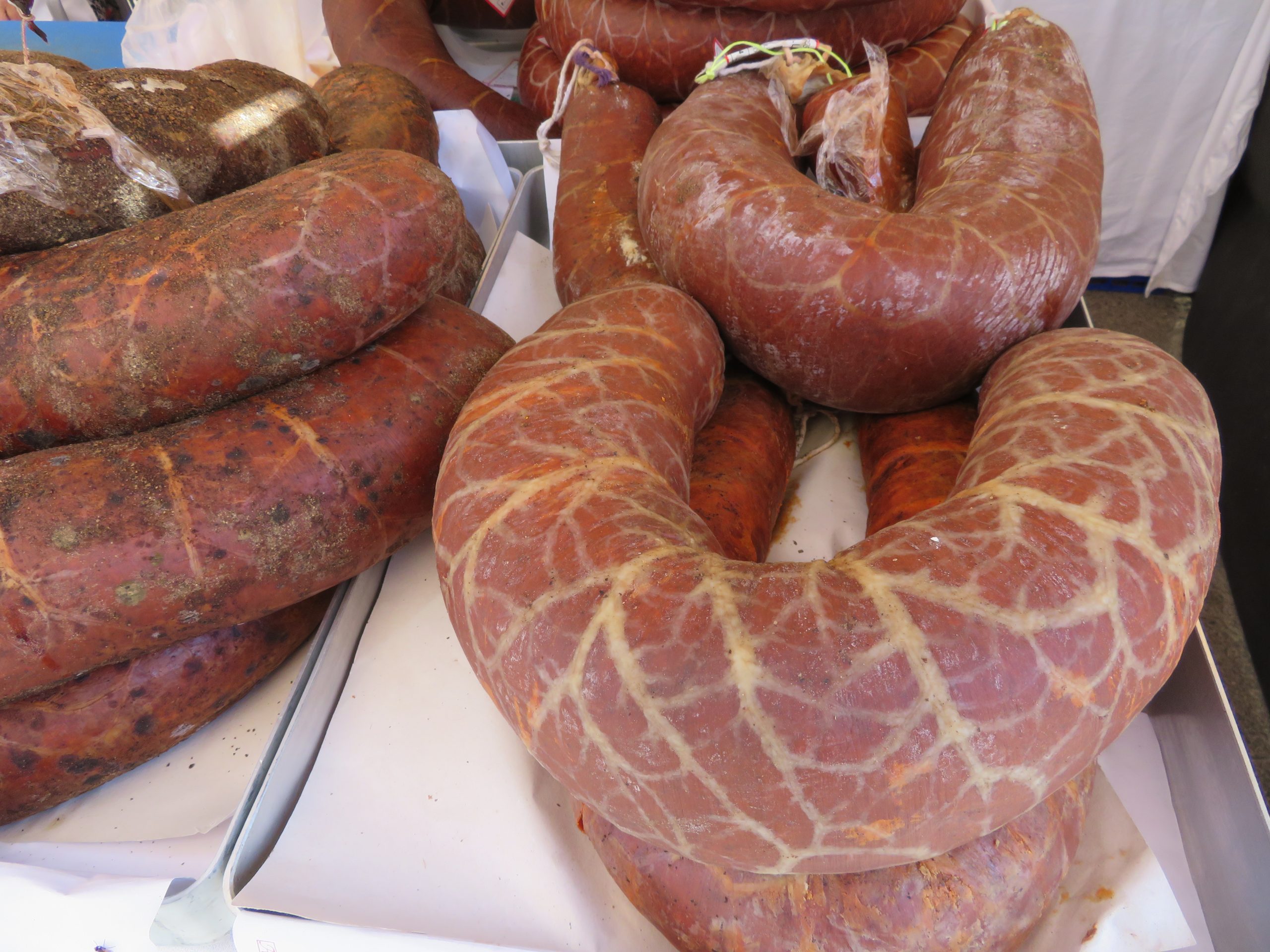
    4. Mallorca Distillery, Palma

    The Palma option, producing under the Palma Gin name and describing itself as the city’s first organic distillery. Founded in June 2018 by Byron and Amber Holland.

    The range is Palma Gin at 46.6%, plus Citrus, Rosé and Spiced expressions, a limited-edition Monastrell, and a vodka. They work from fifteen locally foraged and organic botanicals, including wild flowers and citrus from rural island orchards, though they do not publish the full list. Bottles are €45 for the standard 70cl expressions and €55 for the Monastrell. Third-party sites advertise tours and a make-your-own-gin class, but the distillery does not currently publish tour information itself, so ring ahead rather than turning up. Do not confuse this business with the separately named Mallorca Gin Distillery in Santa Catalina, whose website is now offline.

    5. Bodegas Suau, Es Pont d’Inca

    Carrer Cabana 12, Es Pont d’Inca in Marratxí, about ten minutes from Palma, in a converted flour mill. The company was founded in Cuba in 1851, and Juan Suau Bennáser moved the stills to Mallorca the same year to make rum, anís, aguardientes and the brandy the name is still known for. It now belongs to the Barceló and Mora families.

    Suau is the entry that connects the modern gin scene to the old one: they made a fully craft gin in 1919 and revived it a century later. The current bottling is Maior Gin, built on local fig, rosemary and Sóller oranges. The older Suau Gin recipe used four distillations in copper with island oranges, lemons and almonds alongside juniper, coriander, angelica, orris and liquorice. The site has visitor and event spaces, but tour details are not published, so contact them directly.

    A guided gin tasting with three glasses in front of a seated guest and a host explaining
    Tasting neat before tasting mixed is the only reliable way to tell the botanicals apart.

    Two more are worth looking for on a shelf rather than visiting. Licors Moyà in Artà, in business since the nineteenth century, launched Baleàric Moyà Nº5 in February 2025, billed as the first gin made with fonoll marí, the rock samphire that grows on the island’s coastal rocks, giving it a saline, mineral finish. Dos Perellons, a family firm dating to 1882 and now in Son Castelló, makes several gins including a blend developed with the chef Koldo Royo. Most of these turn up behind the counter at the Old Town tapas bars if you want to try before buying a bottle.

    What Goes Into a Mallorcan Gin

    Juniper berries, dried orange peel, rosemary, thyme, fennel and almonds laid out as gin botanicals
    Citrus and mountain herbs do most of the work in island gins. Juniper is often the quietest note.
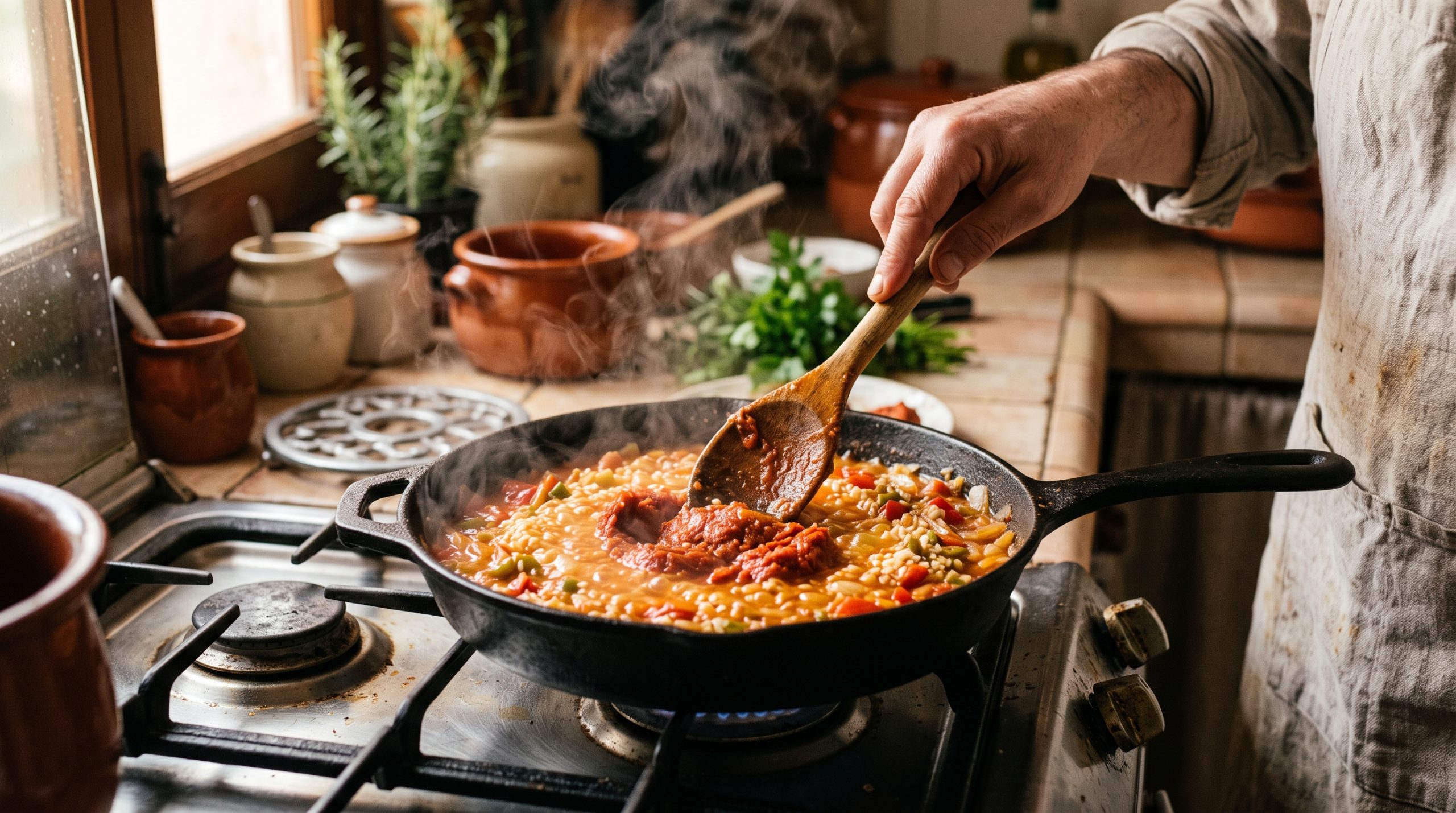
    What distinguishes the island’s gins is less the juniper than everything around it. Mallorca grows citrus in a mountain valley with its own microclimate, herbs on dry limestone slopes, and edible plants on the coastal rocks, and the producers have leaned hard into all three. The method most of them share is worth knowing too: rather than macerating a basket of botanicals together, they distil each one separately at its seasonal peak and blend the distillates afterwards, in the way a winemaker assembles a coupage.

    Island Botanicals To Look For

    • Sóller oranges and lemons — the valley behind the Tramuntana, and the single most common island signature.
    • Canoneta orange — a local variety specific to that valley, used by Gin Eva in a gin named after it.
    • La Mallorquina olive — a single olive variety from Valldemossa, distilled once a year.
    • Fonoll marí — rock samphire from the coast, which brings salinity rather than sweetness.
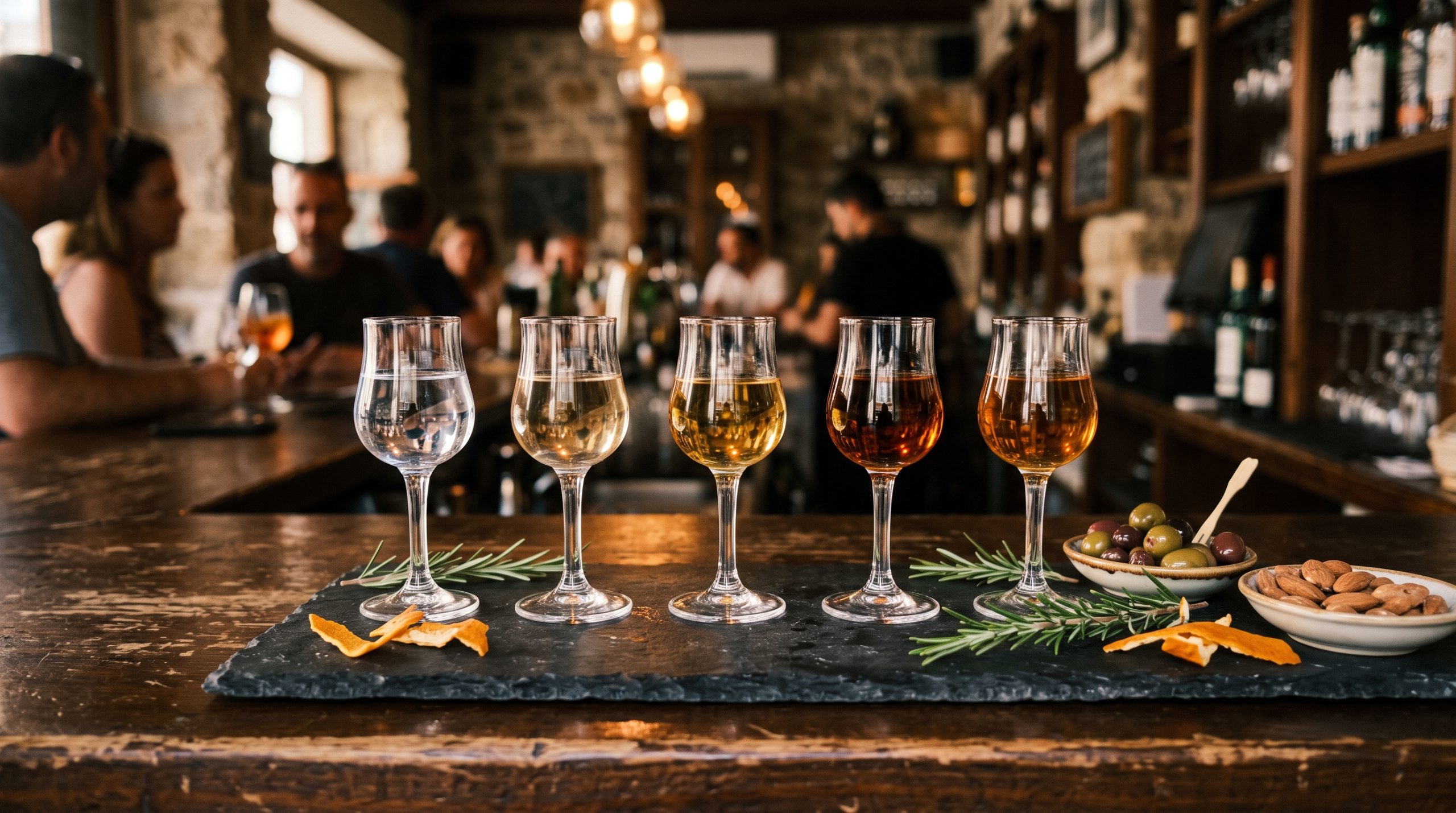
    • Tramuntana thyme and rosemary — the dry-slope herbs, giving the resinous edge.
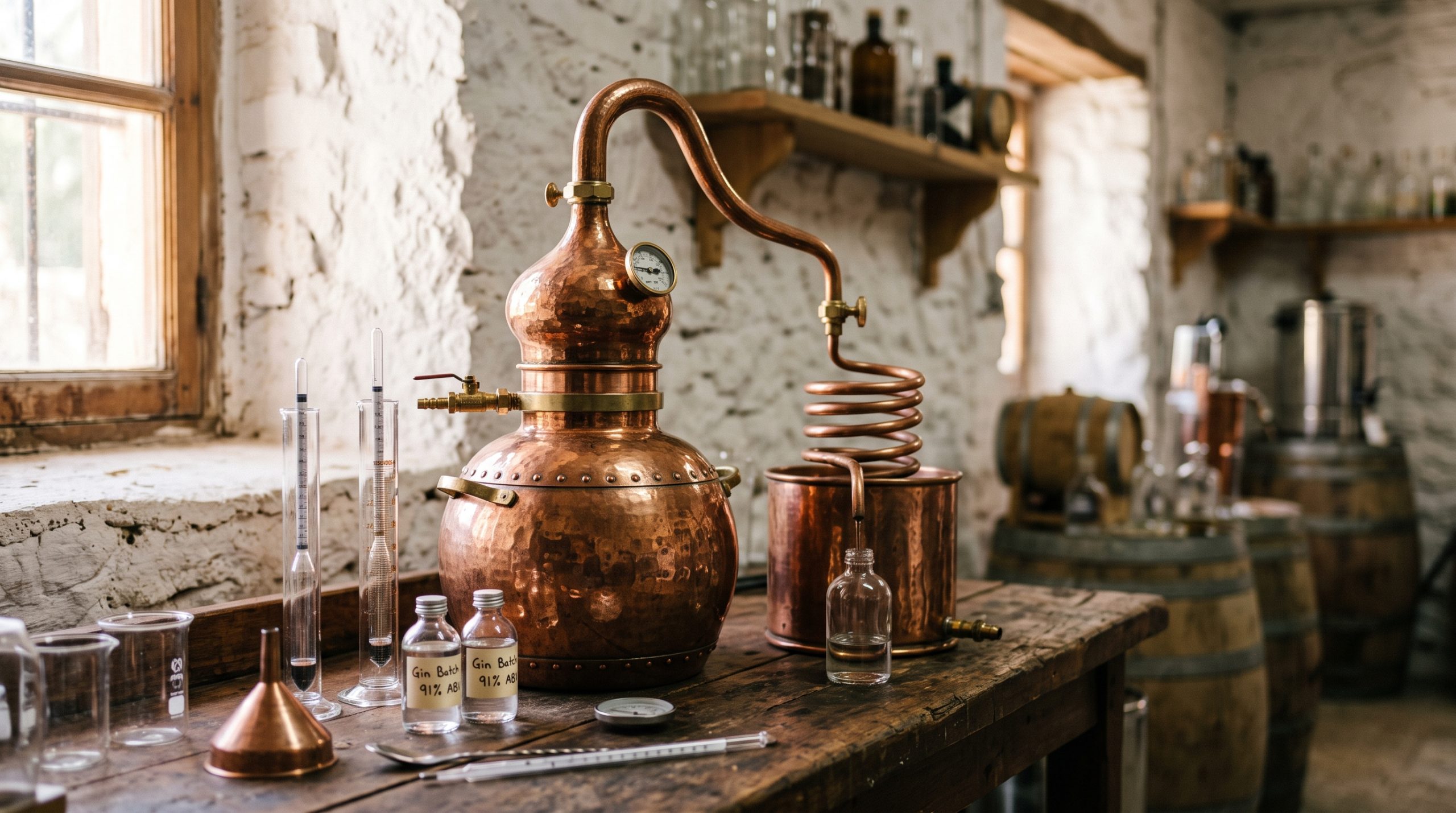
    • Wild fennel, myrtle and lemon verbena — the softer aromatics that fill the middle of the palate.

    Inside A Tasting Palma Experience

    Taste the island without hiring a car

    Three Cabraboc gins from Sóller tasted neat and mixed, then a Palo and a Hierbes to finish, in our Old Town tasting room rather than an hour up the coast.

    The Tasting Palma tasting room set with wine glasses and small plates A small group raising glasses in a toast around a long shared table A flight of five Mallorcan wines paired with small tapas plates A guide showing a small group around a stall at the Olivar Market Guests preparing Mallorcan tapas with a chef in a cooking class A speciality coffee cupping set up with grinder, scales and tasting cups
    Book the Gin Tasting

    From €44 · 60 minutes · Max 10 guests · Gift vouchers available

    Palo and Herbes: The Island’s Protected Spirits

    Shelf of clear glass spirit bottles and jars of botanicals in a small distillery shop
    Island distilleries tend to sell direct from the still room, which is often the only place to find the limited bottlings.

    Gin may be new here, but two Mallorcan spirits carry protected geographical indications, and any serious tasting on the island will include both. They are also what people actually drink, which gin still mostly is not.

    Palo de MallorcaHerbes de Mallorca
    StatusProtected Geographical IndicationProtected Geographical Indication
    Made fromMaceration or infusion of calisaya quinine bark and gentian root, with sugar, caramelised sucrose and alcoholAn anise-based spirit blended with a solution flavoured by aromatic plants
    Tastes likeDark, bitter, faintly medicinal. Closer to an amaro than a liqueurSweet to dry depending on style, led by anise and mountain herbs
    StylesOneThree: dulçes, mescladas, seques
    StrengthAround 30%Dulçes from 20%, mescladas from 25%, seques from 35%
    How it is drunkWith soda and a slice of lemon, as an aperitifNeat and cold, usually after a meal

    The name Palo comes from palo de quina, the quinine bark it is made with, and it is genuinely an acquired taste. Production was around 34,000 litres in 2025, up roughly a quarter on the year before, so the acquired taste is being acquired by more people. Herbes divides by sugar content: the sweet style must carry at least 300 grams of sugar per litre, the dry style no more than 100, and the mixed style sits between them. Typical plants include lemon verbena, chamomile, rosemary, fennel and lemon balm, plus orange and lemon tree leaves. A small glass of the dry style after an ensaimada and a coffee is a very Mallorcan way to end a morning.

    Where to Taste Mallorcan Gin in Palma

    A gin and tonic in a balloon glass garnished with orange peel and rosemary on a marble bar
    Garnish to the botanical, not to the glass. A citrus-led island gin wants peel, not cucumber.

    The distilleries themselves are spread across the island, which is the practical problem. Sóller is an hour from Palma by road or a scenic ride on the old wooden train, Llucmajor and Llubí need a car, and the Palma-based producer does not publish visiting hours. If you are here for a few days without transport, that rules most of it out.

    The alternative is to taste in the city. Palma’s better bars carry island gins as a matter of course, and a well-made Spanish gin and tonic is its own discipline: a balloon glass, plenty of clear ice, a tonic chosen to sit under the botanicals rather than over them, and a garnish that matches what is actually in the bottle. Orange peel for a Sóller citrus gin, rosemary or thyme for a herbal one, and nothing at all for the olive gin, which does not need help.

    Our own tasting exists for exactly this reason. It runs sixty minutes for a maximum of ten people at our Old Town room, works through three Cabraboc gins tasted neat and mixed, then a Palo with soda and a Hierbes de Mallorca to finish, with a tapita alongside each. It covers the distillation process, botanical selection and how to build the G and T properly, without needing a car. The full range of tastings and food experiences runs from the same room.

    Frequently Asked Questions

    What Gin Is Made in Mallorca?

    The main island producers are Cabraboc in Sóller, Gin Eva in Llucmajor, Destilería Pareis in Llubí, Mallorca Distillery in Palma under the Palma Gin name, and Bodegas Suau at Es Pont d’Inca with Maior Gin. Licors Moyà in Artà and Dos Perellons also produce gin.

    Is Gin Xoriguer From Mallorca?

    No. Gin Xoriguer is made in Maó on Menorca under the Gin de Mahón protected designation. It is the most famous gin of the Balearics and the one most often assumed to be Mallorcan, but it comes from a different island. No Mallorcan gin holds a protected geographical indication.

    Can You Visit a Gin Distillery in Mallorca?

    Yes. Cabraboc has a shop and tasting room in Sóller open weekdays and Saturday mornings, where you can taste widely and blend your own. Gin Eva runs a bookable hour-long tasting at Casa Eva in Llucmajor for up to twelve people. Destilería Pareis opens to visitors on weekday mornings and holds a stall at Sineu market on Wednesdays.

    Where Can You Do a Gin Tasting in Palma?

    Most distilleries sit outside the city and need a car. In Palma itself, our Mallorcan Gin Tasting runs 60 minutes for up to ten guests at our Old Town tasting room, covering three Cabraboc gins neat and mixed plus Palo and Hierbes de Mallorca, each with a small bite.

    What Botanicals Are Used in Mallorcan Gin?

    Alongside juniper, the recurring island botanicals are Sóller valley oranges and lemons, the local canoneta orange, the Mallorquina olive from Valldemossa, rock samphire, Tramuntana thyme and rosemary, wild fennel, myrtle, lemon verbena and almond. Most producers distil each botanical separately and blend afterwards.

    What Is Palo de Mallorca?

    A dark bitter aperitif holding a Protected Geographical Indication, made by macerating calisaya quinine bark and gentian root with sugar, caramelised sucrose and alcohol. It sits around 30% and is drunk with soda and lemon. The name comes from palo de quina, the quinine bark itself.

    What Are Hierbes de Mallorca?

    A protected herbal liqueur built on an anise spirit flavoured with island plants such as lemon verbena, chamomile, rosemary, fennel and lemon balm. It comes in three styles: sweet from 20% with at least 300g of sugar per litre, mixed from 25%, and dry from 35% with no more than 100g. It is drunk cold after eating.

    Taste With Us

    The Spirit of the Tramuntana, without leaving the Old Town

    Sixty minutes, ten guests maximum. Three Cabraboc gins tasted neat and with mixers, a Palo de Mallorca and a Hierbes to finish, each with a tapita chosen to match. From €44 per person.

    Check availability

    Private and corporate groups up to 32 guests · Get in touch